Table of Contents
When comparing 1000V vs 1500V solar connectors, the main difference is not simply the voltage number printed on the housing.
The connector belongs to a complete photovoltaic DC architecture.
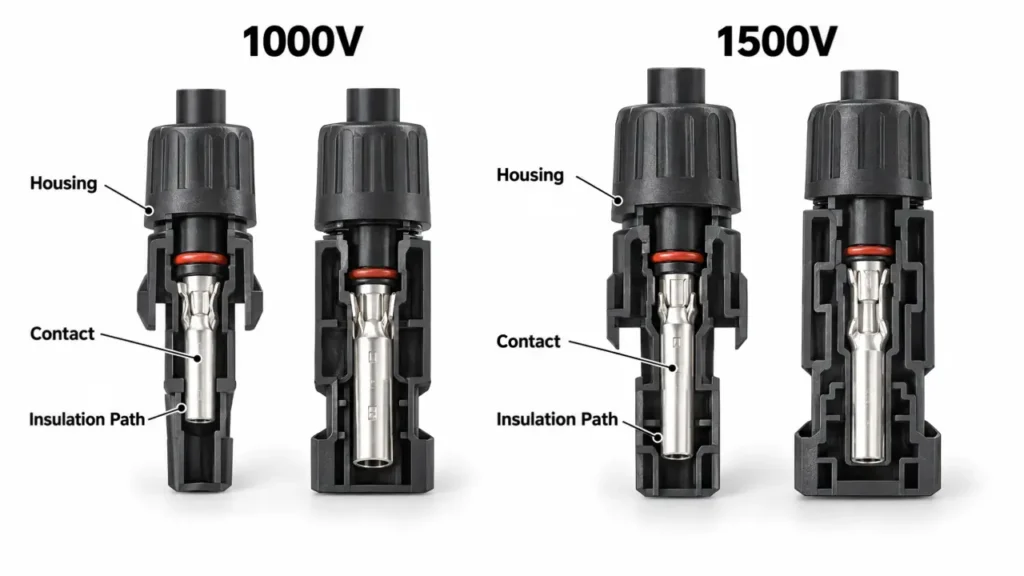
A 1500V connector is designed and evaluated for use in a higher-voltage connection system. That can affect insulation design, spacing, housing geometry, materials, testing and the compatible cable and mating components.
But installing a 1500V connector does not turn a 1000V PV system into a 1500V system.
The complete circuit—including modules, cable, connectors, combiner equipment, protection devices and inverter input—must support the intended system voltage.
UHCCY offers both 1000V and 1500V Solar Connector platforms for different PV system architectures.
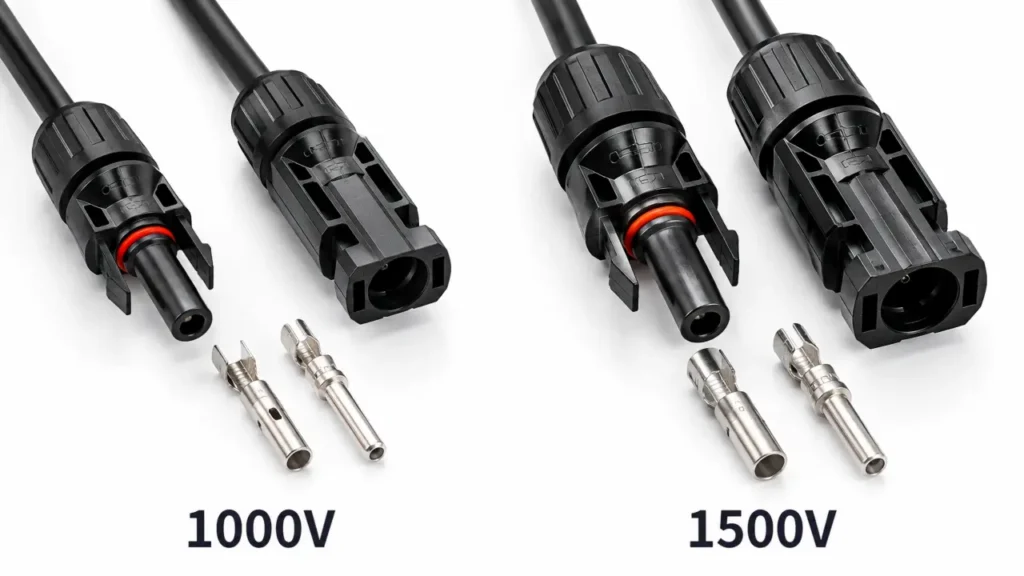
What Is the Difference Between 1000V and 1500V Solar Connectors?
The basic difference is the rated DC system voltage for which the connector platform has been designed and evaluated.
| Parameter | 1000V connector platform | 1500V connector platform |
|---|---|---|
| Rated voltage class | Up to the specified 1000V DC rating | Up to the specified 1500V DC rating |
| Typical system architecture | 1000V PV arrays | 1500V PV arrays |
| String design | Lower maximum string voltage | Can support higher permissible string voltage |
| Insulation design | Designed for its stated voltage class | Must accommodate the higher voltage class |
| Cable/equipment requirement | Complete system must suit 1000V architecture | Complete system must suit 1500V architecture |
| Current rating | Model-specific | Model-specific |
| Connector size | Product-specific | Product-specific |
The important point is that:
1500V does not automatically mean higher current, larger cable or better connector quality.
Voltage rating and current rating are separate specifications.
For the general relationship between current, cable size and connector ratings, see MC4 Connector Specifications.
Why PV Systems Moved From 1000V Toward 1500V
The move toward higher PV system voltage is mainly a system architecture decision.
For a given power:
P = V × I
Increasing voltage can allow the same power to be transferred at lower aggregate current elsewhere in the system architecture.
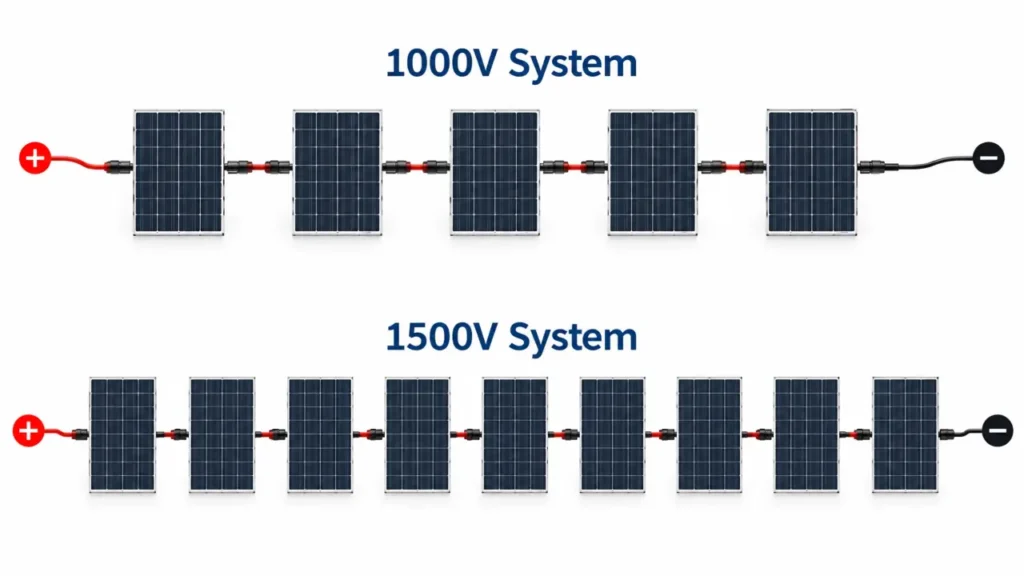
More importantly for a solar array, a higher maximum system voltage can allow more modules to be connected in each series string, provided all equipment limits are respected.
That can reduce the number of parallel strings required for the same total array power.
In suitable large projects, this can reduce requirements for items such as:
- parallel string connections
- combiner inputs
- DC cable runs
- some balance-of-system components
This is one reason 1500V architectures became important in commercial and utility-scale PV.
But it does not follow that:
1500V is automatically better for every PV installation.
The system size, inverter design, module voltage, regional requirements and available components all matter.
Higher Voltage Can Allow Longer Series Strings
When modules are connected in series:
string voltage adds
while string current remains approximately the current of one matched module.
A system with a higher permitted DC voltage can therefore potentially place more modules in one series string.
Conceptually:
1000V architecture → fewer modules per maximum-voltage string
1500V architecture → potentially more modules per string
But this is not determined by the connector alone.
The string length must remain within the limits of:
module → connector → cable → DC protection → inverter
The component with the lowest applicable voltage rating can become the limiting component.
Cold-Weather Voc Still Determines the Maximum String Length
One of the most important mistakes to avoid is calculating string length only from the module’s nameplate open-circuit voltage at standard test conditions.
PV module Voc normally increases as cell temperature falls.
Therefore:
maximum string voltage in cold conditions can be higher than the simple STC sum.
A 1500V connector does not change that physics.
When determining the maximum number of modules in series, the project needs to account for:
- module Voc
- module temperature coefficient
- minimum expected design temperature
- number of modules in series
- maximum DC input voltage of the inverter
- voltage ratings of all other DC components
The same principle applies to 1000V systems.
For series-string behavior, see the MC4 Connector Wiring Guide.
A 1500V Connector Is More Than a 1000V Connector With a New Label
A properly designed 1500V connector platform may require changes to the insulation system compared with a lower-voltage design.
Relevant design considerations can include:
- clearance
- creepage distance
- insulation thickness
- housing geometry
- material properties
- overvoltage performance
- pollution conditions
- dielectric testing
- connector interface design
However, there is no useful universal rule such as:
“1000V connector = X mm creepage”
and:
“1500V connector = Y mm creepage.”
Those values depend on the specific insulation coordination, materials, product construction and applicable standard.
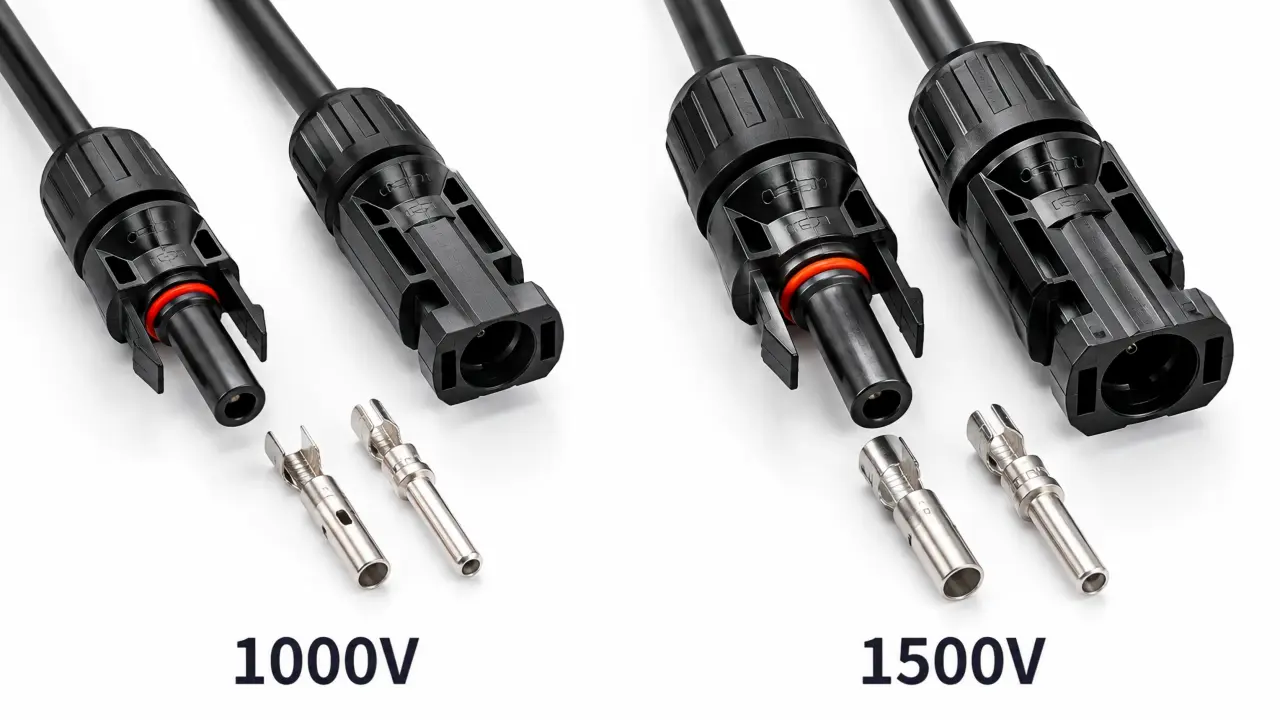
This is why visually similar connectors cannot be assumed to have the same voltage rating.
UHCCY’s 1000V UH-PC-MC01 and 1500V UH-PC-MC04 are separate connector platforms with their own model-specific specifications.
1500V Does Not Automatically Mean Higher Current
Voltage and current are independent connector specifications.
For example, a connector can be:
1000V / 30A
or:
1000V / 50A
while another product can be:
1500V / 30A
or:
1500V / 60A.
The 1500V number tells you about the connector’s voltage class.
It does not tell you its current capability.
Current rating depends on factors such as:
- contact design
- conductor cross-section
- contact resistance
- temperature conditions
- applicable test and certification basis
This is particularly important when purchasing connectors because a seller may emphasize:
“1500V”
while providing insufficient information about the actual current/contact configuration.
UHCCY’s 1500V high-current platform, for example, includes separate conductor and current configurations rather than treating 1500V as one universal current rating.
1500V Does Not Automatically Require a Larger Cable
Another common misunderstanding is:
1500V system = larger cable
Not necessarily.
Cable cross-section is primarily influenced by:
- circuit current
- ampacity requirement
- cable length
- voltage drop
- installation conditions
Voltage rating is a separate property.
A higher-voltage system may actually reduce aggregate current for a given total plant power by enabling a different series/parallel architecture.
But the cable insulation itself must still be suitable for the intended system voltage.
Therefore a cable needs to satisfy both:
electrical conductor requirement
and:
voltage/insulation requirement.
For UHCCY cable options, see Solar Cable.
Can a 1500V Connector Replace a 1000V Connector?
A higher voltage rating does not automatically make a connector a direct replacement.
Suppose a 1000V connector in an existing array is damaged.
Installing a 1500V connector with a similar shape does not prove:
- mechanical compatibility
- contact compatibility
- cable compatibility
- approved mating compatibility
- correct sealing
- correct tooling
Voltage rating is only one specification.
The replacement still needs to match the defined connector system.
Similarly:
A 1500V connector should not be mixed with a 1000V connector simply because both sides physically mate.
For mixed connector systems, see MC4 Connector Compatibility.
When a 1000V Solar Connector Still Makes Sense
A 1000V connector platform remains appropriate where the complete PV system has been designed around a maximum voltage within that class.
Typical applications can include:
- residential PV
- smaller commercial systems
- legacy 1000V installations
- replacement work in documented 1000V systems
- equipment whose DC input architecture is limited to 1000V
The decision should not be based on the idea that 1000V is “old” or inferior.
If the array, inverter and other DC equipment are designed around 1000V, a correctly selected 1000V connector is the appropriate component.
For UHCCY applications, UH-PC-MC01 provides a 1000V cable-to-cable platform for 2.5, 4 and 6 mm² PV conductors.
When a 1500V Solar Connector Makes Sense
A 1500V connector is relevant when the complete array has been designed for a 1500V DC architecture.
Typical applications include:
- larger commercial arrays
- utility-scale PV
- systems using longer series strings
- projects designed to reduce the number of parallel strings
- equipment platforms specifically rated for 1500V DC
The connector must still be selected according to:
current → conductor → cable OD → connector family → mating pair → environmental requirements
not voltage alone.
UHCCY’s UH-PC-MC04 1500V Solar Connector supports multiple conductor/current configurations for high-voltage PV wiring.
IEC 62852 and 1500V PV Connectors
The main international product standard for photovoltaic DC connectors is IEC 62852.
Its current consolidated edition covers connectors for PV DC circuits with rated voltages up to 1500V DC and rated currents up to 125A per contact within the scope of the standard.
Official reference: IEC 62852 — Connectors for DC application in photovoltaic systems
That scope statement needs to be understood correctly.
It does not mean:
any IEC 62852 connector = 1500V / 125A.
The exact connector still has its own rated voltage, rated current, cable range and certified configuration.
This distinction matters for procurement because the scope limit of a standard must not be copied into a product specification.
Certification Must Match the Exact Voltage Variant
A manufacturer may offer:
1000V version
and:
1500V version
within a visually similar product family.
Do not assume that certification for one automatically covers the other.
When reviewing supplier documentation, verify:
- exact connector model
- rated voltage
- rated current
- conductor range
- cable OD
- mating counterpart
- standard
- certificate/model coverage
This becomes especially important when a supplier catalog lists many versions under one broad product title.
For B2B procurement, the certificate should support the exact configuration being quoted.
How to Specify 1000V or 1500V Connectors in an RFQ
Avoid purchasing descriptions such as:
“Need 1500V solar connector.”
A more useful RFQ defines the complete requirement.
| Requirement | Example information |
|---|---|
| System voltage | 1000V DC or 1500V DC |
| Connector function | Inline / panel-mount / branch / fuse |
| Required current | Project requirement |
| Conductor | Required mm² |
| Cable OD | Actual PV cable diameter |
| Mating counterpart | Exact connector family/model |
| Environmental requirement | Project-specific |
| Certification | Destination-market requirement |
| Termination | Field crimp / preassembled |
| Quantity | Project or wholesale quantity |
| OEM | Marking, packaging or cable assembly requirements |
The useful sequence is:
System voltage → Circuit current → Cable → Connector platform → Mating pair → Documentation
This produces much more comparable quotations than voltage alone.
What About 2000V PV Systems?
The market is beginning to move beyond 1500V in selected high-voltage PV applications.
That does not mean 1500V is becoming obsolete.
A move from 1500V to 2000V requires another system-level transition involving:
- modules
- cable
- connectors
- switching
- protection
- combiner equipment
- inverter architecture
- standards and certification
The same principle that applies between 1000V and 1500V applies again:
A higher-voltage connector is useful only when the complete PV system is designed for that voltage.
UHCCY also has a 2000V Solar Connector platform for project-specific high-voltage requirements, but 2000V applications should be evaluated according to the applicable market and project documentation rather than treated as a default replacement for 1500V systems.
Key Takeaway
The difference between 1000V and 1500V solar connectors is fundamentally a system-voltage difference, not a simple product upgrade.
A useful selection logic is:
Maximum system voltage → cold-weather string Voc → equipment voltage class → connector voltage rating → current requirement → cable → mating system.
Remember:
- A 1500V connector does not convert a 1000V system into a 1500V system.
- Higher system voltage can allow longer series strings when the complete system supports it.
- Cold-weather Voc must remain within the maximum system voltage.
- 1500V connector design may require different insulation coordination from a 1000V product.
- Voltage rating does not determine current rating.
- 1500V does not automatically require a larger conductor.
- A higher-voltage connector is not automatically a compatible replacement for a lower-voltage connector.
- Certification must correspond to the exact voltage/model configuration.
- For procurement, specify the complete cable and connector system rather than voltage alone.
- 2000V is an emerging project-specific platform, not a reason to skip proper 1500V system design.
The most important question is therefore not:
“Is 1500V better than 1000V?”
It is:
“Which voltage architecture is the complete PV system designed and approved to use?”