Table of Contents
Solar connector quality control should begin before a purchase order is placed, not after finished connectors arrive at the warehouse.
A connector can have the correct voltage printed on the housing, look clean in a sample photograph and still leave important questions unanswered:
- Which contact belongs to this exact housing?
- Which conductor and cable OD were used for qualification?
- Which mating counterpart was tested?
- Which crimp tooling is required?
- Does the certificate cover this exact model?
- Can the supplier change contact material, seal, housing resin or tooling without notifying the buyer?
- Will the production batch remain identical to the approved sample?
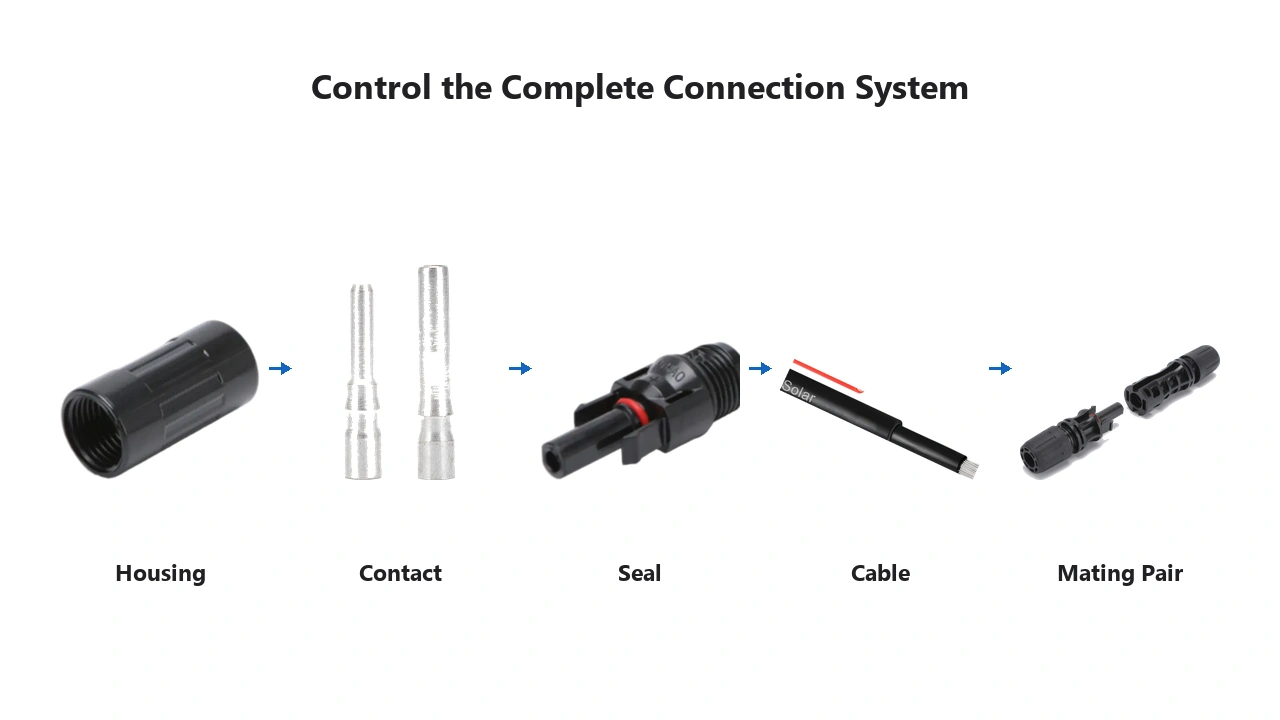
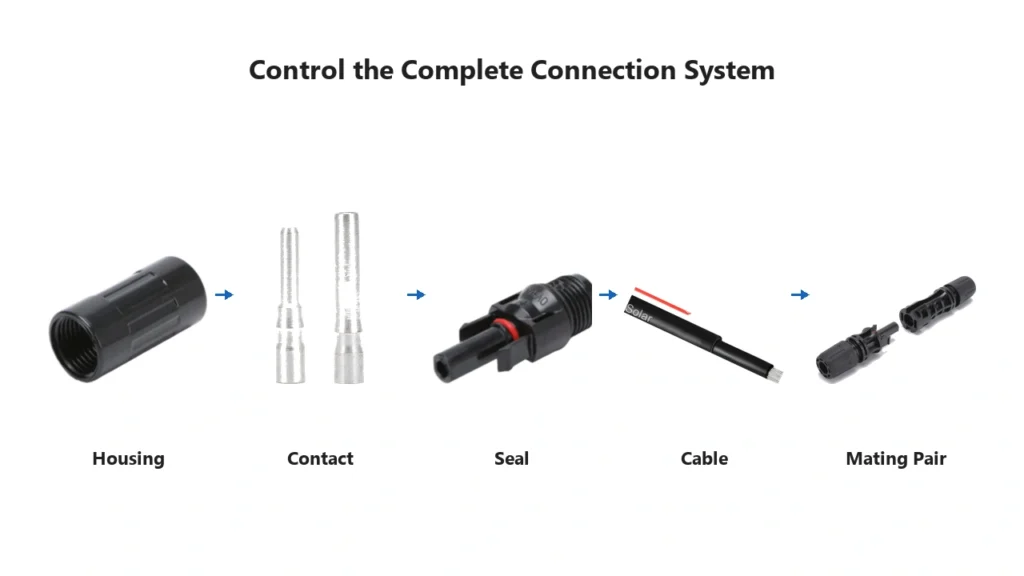
For B2B procurement, the connector should therefore be treated as a controlled connection system:
Cable → Contact → Crimp → Housing → Seal → Mating Counterpart → Assembly Process
That complete configuration—not one individual plastic housing—is what ultimately performs in the PV system.
This guide focuses on how buyers, distributors, OEMs and project teams can qualify and control PV connector supply without relying only on catalog claims.
What Solar Connector Quality Control Should Cover
Quality control is often reduced to:
“Does the factory test the connectors?”
That question is too broad.
A useful quality system needs to control several layers:
| Layer | Main Question |
|---|---|
| Product identity | Are we receiving the exact approved model? |
| Materials | Are contact, housing and seal materials controlled? |
| Dimensions | Are critical mating and sealing dimensions consistent? |
| Electrical path | Is contact resistance stable and appropriate? |
| Mechanical assembly | Are contacts retained and housings correctly assembled? |
| Cable termination | Is the cable/contact/tool combination controlled? |
| Mating interface | Is the approved counterpart clearly defined? |
| Environmental performance | Does the configuration support its claimed application? |
| Documentation | Do certificates and reports apply to the supplied model? |
| Production consistency | Is the production batch equivalent to the approved sample? |
| Traceability | Can a later problem be traced to a batch and configuration? |
This distinction matters because qualification testing, factory process control and final inspection are different activities.
A connector that once passed a laboratory test is not automatically evidence that every later production batch remains unchanged.
Freeze the Exact Product Configuration Before Approval
One of the most useful improvements a professional buyer can make is to stop approving products only by a broad sales name such as:
“1500V solar connector, 4 mm².”
That description leaves too much room for variation.
The approved product reference should identify, where applicable:
Connector model → Housing revision → Contact → Contact plating → Seal → Cable range → Mating counterpart → Tooling / termination method
For preassembled cable products, also add:
Cable manufacturer/type → Conductor cross-section → Cable OD → Finished length → Crimp process
This creates what can effectively become a frozen approved configuration.
Why BOM Control Matters
The sample you approve and the product delivered six months later can appear identical while internal details have changed.
Possible substitutions can include:
- different copper alloy;
- different contact plating;
- thinner metallic components;
- different housing resin;
- different sealing material;
- revised crimp terminal;
- different subcontracted cable;
- different assembly tooling.
Some changes may be perfectly acceptable.
The problem is uncontrolled change.
For repeat B2B supply, the buyer should therefore define which changes require notification or reapproval.
A useful purchasing rule is:
No material, contact, cable, sealing or mating-interface change without documented review when that change affects the approved configuration.
Solar connector quality control checklist for housing contact cable seal and mating connectorVerify Certifications at the Exact Model Level
A certificate logo is not enough.
The useful question is:
Which exact product configuration does this certificate cover?
For PV connectors, check:
- manufacturer named on the document;
- certificate holder;
- model or product family;
- voltage;
- current range;
- cable/conductor range;
- mating pair;
- applicable standard;
- revision/date;
- certification body or laboratory.
IEC 62852 is the principal international product standard for DC connectors used in photovoltaic systems. Its current consolidated edition covers connectors within its scope up to 1500 V DC and 125 A per contact.
That does not mean:
IEC 62852 connector = 1500V / 125A.
Those figures are the scope limits of the standard.
The actual product still has its own certified ratings.
Similarly, current UL 6703 explicitly identifies PV connectors together with their compatible mating parts and generally expects them to be from the same brand unless an intermateability evaluation covers multiple manufacturers.
Standard, Certificate and Certification Body Are Different
Buyers should keep these terms separate:
IEC 62852 → product standard
UL 6703 → product standard
TÜV / UL / other laboratory or certification organization → organization involved in testing or certification
RoHS → restricted-substance compliance
CE marking / declaration → regulatory conformity mechanism where applicable
These are not interchangeable claims.
For example:
“TÜV connector”
does not tell you which standard was applied or which model is covered.
Likewise:
“RoHS compliant”
does not establish connector electrical reliability, sealing performance or mating compatibility.
Special Attention Above 1500V
IEC 62852 currently has a scope up to 1500V DC.
Therefore, if a supplier offers a 2000V PV connector, do not automatically accept:
“IEC 62852 certified 2000V connector”
without checking what documentation actually supports the 2000V claim.
The appropriate approval route may depend on the product, market and project.
UHCCY already applies this distinction to its 2000V platform: IEC 62852 itself should not be presented as though its scope extends to 2000V.
Check Materials, Dimensions and Mating Interfaces
A connector cannot be evaluated only from the material names printed in a catalog.
For example:
Copper contact
is incomplete.
Useful questions include:
- What copper alloy?
- What plating?
- What plating specification?
- Are different current versions using different contacts?
- Is the contact thickness controlled?
- Is the spring/contact geometry fixed?
Likewise:
PC housing
or:
PPO housing
does not by itself prove the performance of the finished connector.
Critical Dimensions Matter
PV connectors rely on mechanical tolerances to establish:
- contact engagement;
- contact pressure;
- locking;
- insulation spacing;
- sealing compression;
- contact retention.
For incoming or supplier qualification inspection, drawings should identify important dimensions rather than requiring buyers to reverse-engineer finished samples.
Do not create arbitrary acceptance tolerances yourself if the supplier has a controlled product drawing.
Use the approved drawing or agreed specification.
Physical Fit Is Not Compatibility
Two connector housings may physically engage and still not form an approved mating pair.
This remains one of the most important procurement controls.
The purchase specification should identify:
the exact mating counterpart
rather than only:
“MC4 compatible.”
See MC4 Connector Compatibility for the dedicated cross-mating discussion.
Control the Cable–Contact–Tooling Combination
A connector housing can be perfectly manufactured while the finished connection still fails because the termination process is wrong.
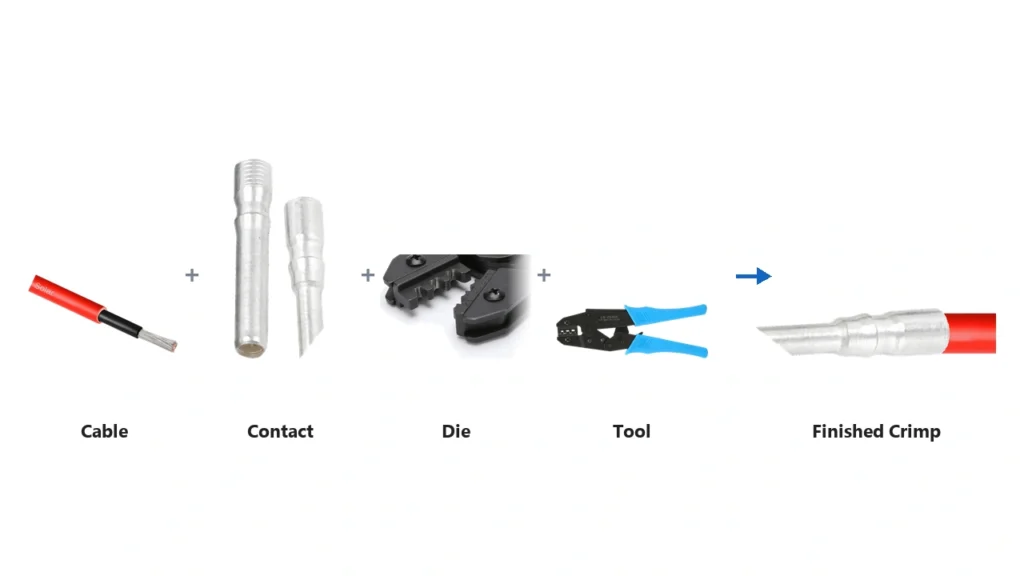
For crimped PV connectors, control:
Cable + Contact + Die + Crimp Tool
as one process.
Important inputs include:
- conductor cross-section;
- conductor construction;
- insulation strip preparation;
- contact reference;
- crimp profile;
- tooling reference;
- tool condition;
- contact insertion;
- contact retention.
Why “4 mm² Tool” Is Not Enough
A crimping tool cavity marked:
4 mm²
does not prove that its crimp geometry is suitable for every 4 mm² PV contact.
Different contact designs can require different compression geometry.
Where product qualification or certification relies on a defined assembly process, the relevant tooling should be identified.
Current UL 6703 requirements were updated in 2024 to include additional provisions relating to field-assembled connector test samples and cyclic pull testing, reinforcing the importance of assembly procedure rather than evaluating only loose connector components.
For field and production crimping principles, see How to Crimp MC4 Connectors and the PV Connector Tools range.
PV connector quality control for cable contact die and crimp toolApprove Samples With a Defined Test Plan
A sample should answer specific questions.
Simply receiving five connectors and confirming that they “look good” provides little evidence.
A useful sample approval can include several levels.
Visual and Dimensional Review
Check:
- product model;
- markings;
- housing consistency;
- contact surface;
- seals;
- cable gland parts;
- mating geometry;
- critical dimensions;
- packaging identification.
Assembly Trial
Use the actual project cable where possible.
Confirm:
- conductor fit;
- cable OD fit;
- stripping process;
- crimping;
- contact insertion;
- contact retention;
- gland assembly;
- connector mating;
- unlocking method.
Electrical and Mechanical Verification
Depending on the project and qualification plan, this can include:
- continuity;
- contact resistance;
- retention;
- pull testing;
- locking/unlocking behavior;
- dimensional verification.
Do not invent universal acceptance values such as:
“Every PV connector must be below X mΩ.”
or:
“Every 4 mm² contact must withstand Y N.”
Acceptance limits should come from:
the applicable standard + exact product specification + qualification documentation + agreed QC plan.
Environmental / Type Testing
Long-duration or destructive evaluations such as environmental cycling, ingress tests and other qualification tests normally belong to product qualification or periodic reliability verification rather than 100% shipment inspection.
This distinction prevents two common mistakes:
Under-testing: doing nothing except visual inspection.
Over-testing: pretending every finished connector must undergo every certification test.
Build Production QC Around Risk, Not Test Quantity
A factory does not become better simply because it advertises:
“100% tested.”
The important question is:
100% tested for what?
Different characteristics require different control methods.
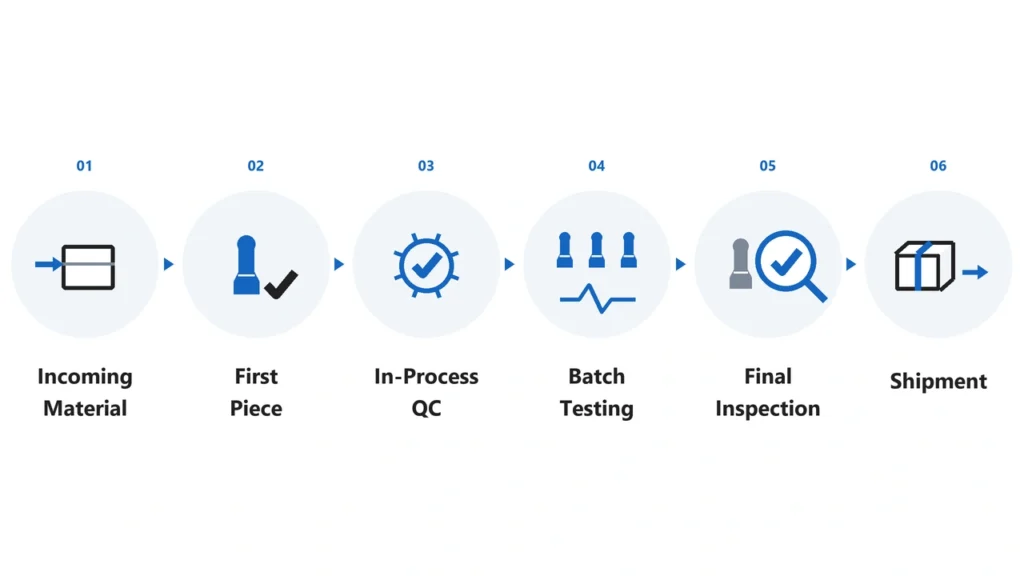
A practical structure is:
| QC Stage | Typical Purpose |
|---|---|
| Incoming inspection | Verify materials and supplied components |
| First-piece approval | Confirm setup before production |
| In-process control | Detect drift during production |
| 100% routine checks | Catch suitable assembly/appearance defects |
| Batch sampling | Verify dimensions, electrical or mechanical characteristics |
| Periodic reliability | Confirm longer-term product/process stability |
| Final inspection | Confirm product, quantity, marking and packaging |
Not every test belongs at every stage.
For example, destructive pull testing cannot sensibly be performed on every connector that will be shipped.
Instead, define:
- sampling frequency;
- lot size;
- inspection characteristic;
- acceptance criteria;
- responsible record;
- action when the result fails.
This is much more meaningful than asking whether a supplier owns a testing machine.
Use Lot Traceability and Change Control
Traceability becomes important when something goes wrong months or years later.
Without it, the investigation quickly becomes:
“We bought black connectors from this supplier sometime last year.”
A more useful production record can connect:
Order → Production Lot → Material Lot → Product Revision → Inspection Record
Depending on order size and project risk, traceability can include:
- batch or date code;
- production date;
- material lot;
- inspection record;
- operator or line;
- tooling reference;
- packaging batch;
- shipment record.
Not every connector requires an individually serialized history.
The objective is practical traceability at a level suitable for the project.
Change Notification Is Part of QC
This is often overlooked.
A supplier may improve or alter:
- raw material;
- contact geometry;
- mold;
- plating process;
- cable;
- seal;
- tooling;
- subcontractor.
A technically acceptable change may still require customer review because it changes the approved product reference.
For repeat OEM orders, define a change-notification requirement before mass production starts.
This is especially important where a certificate, project approval or cable assembly was validated against a specific configuration.
Verify Mating Compatibility Before Production
Connector qualification should never stop at:
“Our male connector and female connector fit together.”
The important question is:
Which exact male and female parts form the tested mating pair?
Current UL 6703 states that connectors are identified and tested with compatible mating parts and that the same brand is expected unless multiple manufacturers are included in the intermateability evaluation.
Therefore a buyer should request:
- connector manufacturer;
- series;
- plug/socket references;
- approved mating pair;
- intended module or equipment counterpart;
- supporting documentation where intermateability is claimed.
Do not assume that:
same diameter + same locking shape + same voltage = compatible pair.
Cross-mating can introduce differences in:
- contact pressure;
- tolerance stack;
- plating;
- seal compression;
- chemical compatibility;
- thermal behavior.
For UHCCY procurement, the safer language is to specify the intended mating counterpart rather than using a blanket “MC4-compatible” requirement.
Run a Practical Pre-Shipment Inspection
Pre-shipment inspection should confirm that the production order still matches the approved configuration.
A useful checklist is:
| Item | Check |
|---|---|
| Product model | Matches PO and approved sample |
| Quantity | Correct shipped quantity |
| Housing | Correct model/revision and no visible defects |
| Contact | Correct contact version and finish |
| Seal/gland | Correct components supplied |
| Marking | Model, polarity and required OEM marking correct |
| Cable version | Correct mm² and OD where preassembled |
| Mating pair | Correct complementary components |
| Assembly | Contact seating and housing assembly correct |
| Functional check | Defined routine electrical/mechanical checks passed |
| Packaging | Prevents component mixing/damage |
| Lot ID | Traceable |
| Documentation | Required certificates/reports supplied |
Do Not Turn PSI Into Certification Testing
Pre-shipment inspection is not a substitute for product qualification.
It is primarily asking:
Did the factory manufacture and pack the product we approved?
Qualification asks:
Can this product meet the required performance and safety requirements?
Both are necessary, but they solve different problems.
Solar connector quality control from incoming inspection to final shipmentRed Flags When Comparing PV Connector Suppliers
A low quotation is not automatically a problem.
An unclear technical quotation is.
Be cautious when a supplier:
Uses One Certificate for Every Product
A broad certificate image on a website is not proof that every listed connector variation is covered.
Ask for the exact model scope.
Cannot Identify the Mating Counterpart
“Universal MC4 compatible” is not enough for a professional PV specification.
Gives Current Ratings Without Contact/Cable Configuration
A range such as:
30–60A
needs to identify which contact and conductor correspond to each rating.
Cannot Provide a Controlled Drawing
This makes dimensional verification and repeat-order control difficult.
Changes Materials Without Documentation
Cost reduction is normal in manufacturing.
Uncontrolled material substitution is not.
Quotes Only Housing Material
“Copper + PPO” does not adequately define contact alloy, plating, seal or assembly configuration.
Cannot Identify the Crimping Process
For preassembled products, a supplier should know what cable, terminal and crimp process are being used.
Treats IP Rating as an Unconditional Property
Ingress-protection claims can depend on correct assembly and complete mating.
Uses Certification Language Imprecisely
Examples include confusing:
standard
with:
certificate
or treating RoHS as proof of electrical product performance.
Refuses Sample-to-Batch Traceability
For repeat project supply, there should be a practical method to identify what was actually manufactured.
Build the RFQ and Quality Agreement Together
The best time to define quality requirements is during quotation—not after a shipment problem appears.
A useful RFQ can contain:
Product Definition
- connector function;
- exact model or required architecture;
- system voltage;
- operating current;
- conductor cross-section;
- cable OD;
- contact/plating requirement;
- mating counterpart;
- environmental requirement.
Documentation Requirement
- datasheet;
- dimensional drawing;
- assembly instruction;
- applicable certificate;
- test report where required;
- material/compliance documentation;
- tooling requirement.
Sample Approval
Define:
- sample quantity;
- cable used;
- required measurements/tests;
- approved markings;
- approved packaging;
- golden sample/reference where appropriate.
Production Quality
Define:
- critical dimensions;
- inspection method;
- sampling requirement;
- lot identification;
- required QC record.
Change Control
State which changes require written notification or reapproval.
Commercial Requirements
Only after the technical configuration is fixed should you finalize:
- MOQ;
- pricing;
- packaging;
- branding;
- lead time;
- annual quantity;
- payment terms.
This order is important.
If branding and price are agreed before the connector configuration is frozen, commercial pressure can begin driving technical decisions backward.
For wholesale and OEM connector configurations, the Solar Connector category should be the starting point. Related cable and termination requirements should then be coordinated with Solar Cable and PV Connector Tools.
Key Takeaway
PV connector sourcing should not be reduced to:
Voltage + Current + IP Rating + Price
A better B2B procurement model is:
Application → Model → Cable → Contact → Tooling → Mating Pair → Documentation → Approved Sample → Production QC → Traceability → Change Control
The most important rules are:
- Approve an exact connector configuration, not only a product name.
- Verify certificate coverage at model/configuration level.
- Do not confuse a standard, certification body and compliance declaration.
- Control cable, contact and crimp tooling as one termination system.
- Use project-specific acceptance limits instead of invented universal QC numbers.
- Separate qualification tests from routine production inspection.
- Define what is checked 100%, what is sampled and what is periodically verified.
- Specify the exact mating counterpart rather than relying on “MC4 compatible.”
- Maintain practical lot traceability for repeat supply.
- Require review of material or design changes that affect the approved configuration.
- Use pre-shipment inspection to confirm production matches approval—not to replace certification testing.
- Freeze the technical specification before negotiating OEM branding and repeat-order pricing.
The better procurement question is not:
“Does this supplier make good solar connectors?”
It is:
“Can this supplier prove that the exact connector configuration we approved can be produced repeatedly, documented correctly and traced when something changes?”