Table of Contents
MC4 male and female connectors are often explained with a simple rule: one connector is positive and the other is negative. In practice, that shortcut can be misleading. Search for MC4 male and female connectors and you may find two apparently contradictory answers:
“The female connector is positive.”
and
“The male connector is positive.”
Both statements can appear in real PV wiring discussions because several different concepts are often mixed together:
- connector housing or coupler type
- metal pin or socket contact
- electrical polarity
- which side of the connection you are looking at
That confusion becomes a problem when someone tries to identify positive and negative wiring only from the shape of a connector.
The safer way to understand a PV connection is to keep connector interface and electrical polarity separate.
UHCCY uses Solar Connector or PV Connector for its own mc4 products. For a broader introduction, see the MC4 Connector Guide.
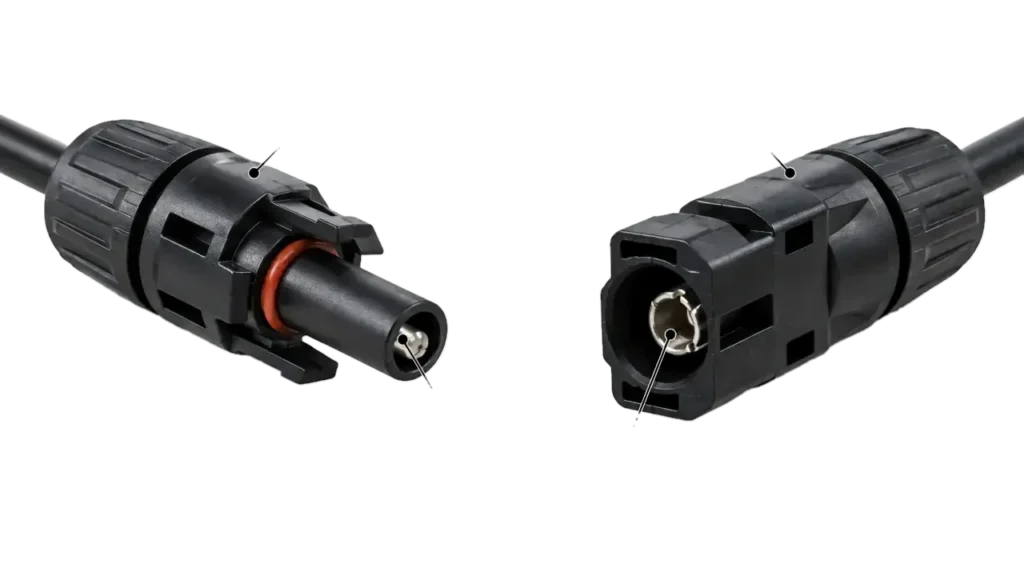
How MC4 Male and Female Connectors Actually Work
The problem starts with the word gender.
People may use male and female to describe different parts of a PV connector.
One person may look at the outer plastic housing.
Another may look at the internal metal contact.
A manufacturer may instead use the more precise terms:
plug and socket
As a result, two people can look at exactly the same connector and use different male/female terminology.
For purchasing and technical documentation, the most reliable reference is therefore:
the manufacturer’s connector designation and part number
rather than the visual appearance alone.
Housing, Contact and Polarity Are Three Different Things
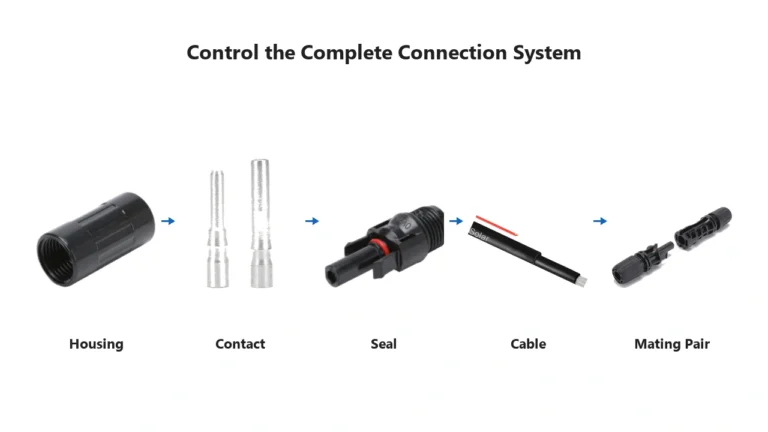
A PV cable connector contains several components, but three concepts are particularly important here.
| Concept | What it describes | Example |
|---|---|---|
| Connector interface | Which connector half mates with the counterpart | Plug / socket |
| Metal contact | Conductive element inside the connector | Pin / socket contact |
| Electrical polarity | Electrical potential carried by the conductor | Positive / negative |
These are related, but they are not synonyms.
A connector can therefore have:
one housing/interface description
a different-looking:
internal metal contact
and then carry:
positive or negative electrical polarity depending on the cable assembly.
This is the distinction that prevents most male/female confusion.
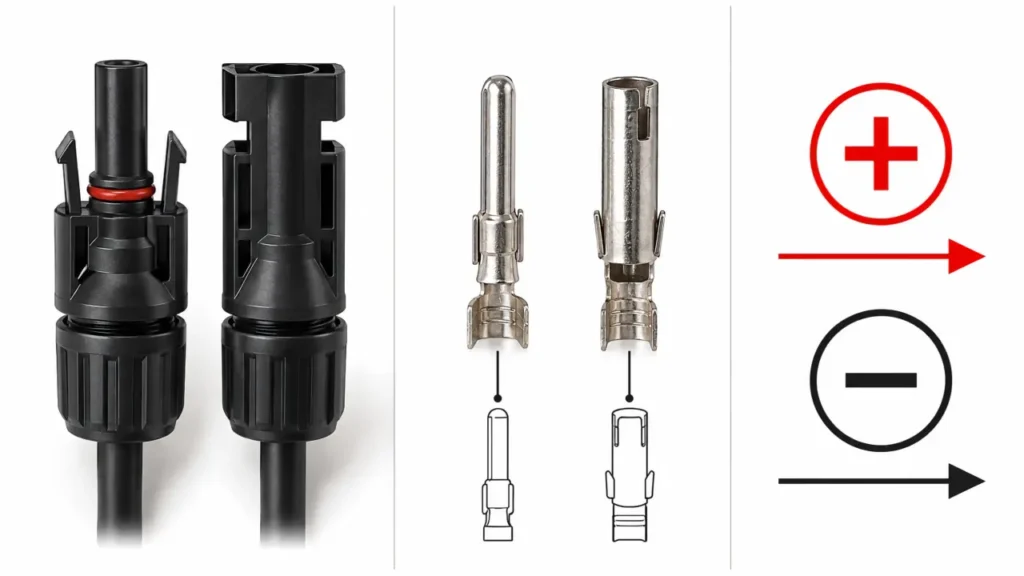
What Does Stäubli Call the Two MC4 Connector Halves?
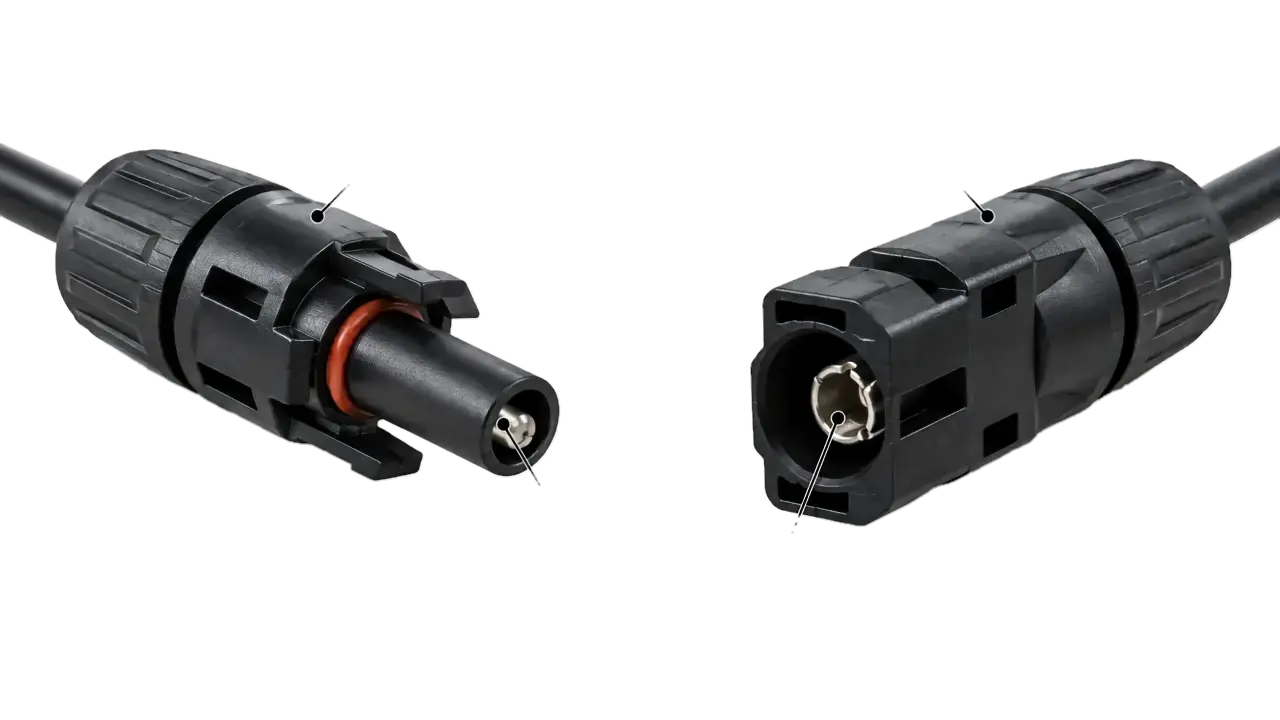
For Original MC4 products, Stäubli uses plug and socket terminology.
Typical product designations include:
PV-KST… — Plug
and
PV-KBT… — Socket
Stäubli documentation may also refer to them as male cable coupler and female cable coupler depending on the product document.
For example, Stäubli’s current MC4-Evo ready technical data identifies:
Socket = positive
Plug = negative
for that connector system.
The manufacturer’s own terminology should therefore take priority when referring specifically to an Original MC4 product.
You can see the product-specific terminology in the official Stäubli MC4-Evo ready assembly instructions.
This does not mean you should identify every cable in a PV installation by assuming:
socket-shaped connector = positive cable
or
plug-shaped connector = negative cable.
That brings us to the most important distinction.
Connector Polarity and Cable Polarity Are Not the Same Question
Suppose a PV module has a positive output terminated with one connector half.
To extend that positive conductor, the extension cable must use the opposite mating connector at the module end.
The electrical polarity stays positive through the connection.
But the physical connector interface changes because:
plug must mate with socket.
That means the connector attached to the positive module lead and the mating connector attached to the positive extension cable cannot both have the same physical interface.
This is why statements such as:
“Male MC4 always means negative.”
or
“Male MC4 always means positive.”
are unsafe when applied to an arbitrary cable assembly.
A better rule is:
Connector gender tells you how two parts mate. Polarity tells you what electrical potential the conductor carries.
Determine them separately.
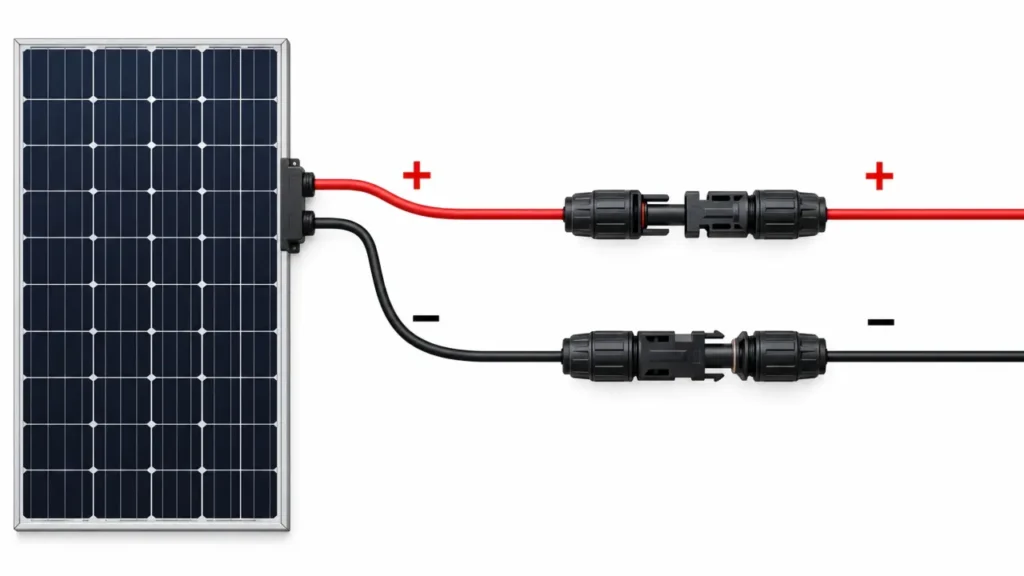
Why a Positive Extension Cable May Have a Different Connector Gender
This is the easiest way to understand the apparent contradiction.
Imagine the positive output from a solar module ends in a socket-style connector.
The positive extension cable must therefore have a plug-style mating connector at the end facing the module.
So both conductors are electrically positive, even though the connector interface changes from:
socket → plug
across the mated connection.
The same principle applies to the negative conductor:
plug → socket
while electrical polarity remains negative.
In other words:
Gender changes across a mating pair. Polarity does not.
This is why connector gender should never be used by itself as a polarity test.
Male vs Female Can Also Refer to the Metal Contact
Another source of confusion is the internal conductive contact.
Inside a PV connector you may find:
- a pin-type contact
- a socket-type contact
The appearance of the outer insulating housing can make the complete connector seem to have the opposite gender from the metal contact inside.
This is why online product listings can be inconsistent.
One supplier may name the product from the housing.
Another may name it from the metal terminal.
A third may follow the original connector manufacturer’s plug/socket designation.
For professional purchasing, avoid relying only on:
“1 pair male + female connector.”
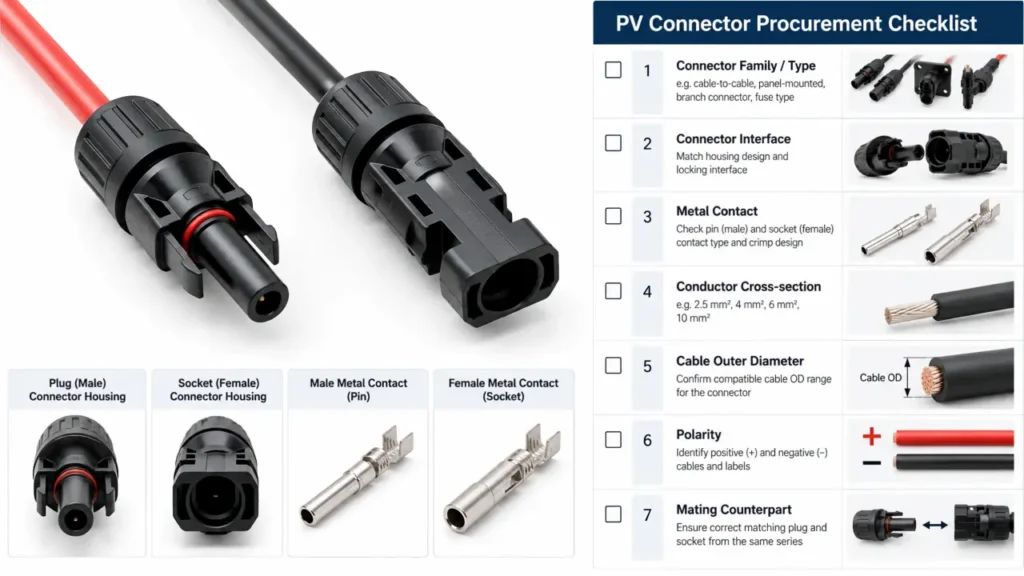
A better specification should identify:
- connector model
- plug/socket part number
- corresponding metal contact
- conductor size
- mating counterpart
- intended polarity marking where applicable
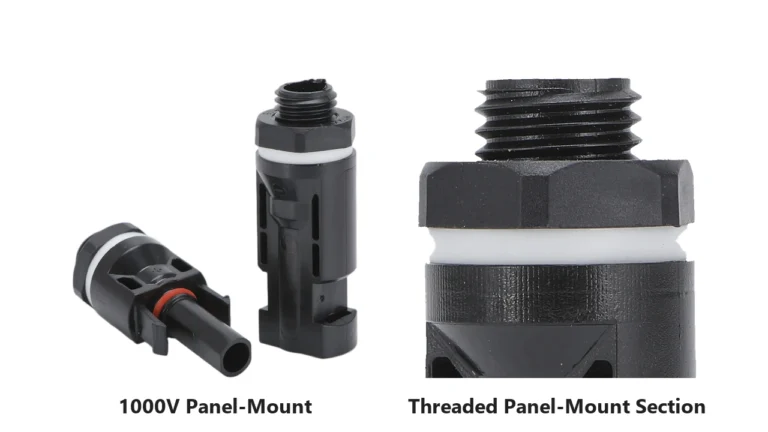
For the broader differences between inline, branch, fuse and panel-mount designs, see MC4 Connector Types Explained.
So Which MC4 Connector Is Positive?
The precise answer depends on what you are asking.
If You Mean an Original MC4 Product Designation
Use the Stäubli documentation for the exact product family.
Some current Stäubli technical documents explicitly define:
Socket = positive
Plug = negative
for the connector product concerned.
If You Mean a Finished Extension Cable
Do not determine its polarity from the connector interface alone.
The polarity depends on how the connector is terminated to the cable.
A positive extension conductor can require the mating connector interface opposite to the connector fitted to the positive module lead.
If You Mean an Unknown Existing Installation
Verify polarity from:
- equipment markings
- module documentation
- cable identification
- system drawings
- appropriate electrical measurement
Do not guess.
How to Identify Positive and Negative Safely
The first source should be the manufacturer’s markings and documentation.
Look for:
+
−
POS
NEG
or equivalent identification.
For preassembled module leads, the module datasheet or installation manual should identify the polarity of each output.
If polarity must be verified electrically, suitable DC-rated test equipment should be used by personnel competent to work on photovoltaic DC circuits.
PV modules can produce voltage whenever sufficient irradiance is present, so an apparently disconnected string may still be energized.
The MC4 Connector Wiring Guide explains polarity together with series and parallel wiring in more detail.
Do Not Use Cable Color as the Only Polarity Check
Red and black are commonly associated with positive and negative DC wiring.
But connectorized PV installations do not always expose differently colored conductors.
Many PV cables are black.
Extension cables may also have been assembled, replaced or relabeled during installation.
Cable color is useful identification when the system has been intentionally designed that way, but it should not override:
- equipment markings
- wiring diagrams
- documented polarity
- verified electrical measurements
The same principle applies to connector shape.
Neither color nor gender should become a substitute for proper identification.
What Happens if MC4 Polarity Is Reversed?
The result depends on where the reversed connection occurs.
Possible consequences include:
- inverter or charge-controller reverse-polarity protection operating
- blown protection devices
- commissioning failure
- reverse voltage across equipment
- equipment damage
- unexpected fault current
In a series string, an incorrectly terminated extension lead can also make troubleshooting particularly confusing because the connectors may still mate mechanically.
The mechanical locking system prevents incompatible connector halves from being pushed together in the normal orientation.
It does not independently verify that the conductor behind each connector has been assigned the correct polarity.
This is an important distinction:
mechanical keying verifies mating geometry—not electrical wiring correctness.
Male/Female Confusion Is Also a Procurement Problem
This subject is not only relevant to installers.
It regularly creates mistakes when PV connectors and cable assemblies are purchased internationally.
Consider a purchase description such as:
“Need 1,000 pairs MC4 male female connectors, 4 mm².”
Several questions remain unanswered.
Which connector system?
Which contact belongs in which housing?
What cable OD is required?
Which half is required on each end of the cable assembly?
What polarity marking is expected?
What connector is it supposed to mate with?
For a loose connector kit, the supplier may simply provide one of each interface.
For a preassembled cable, however, orientation matters.
A better cable-assembly specification looks like:
| Requirement | Example information |
|---|---|
| Cable | PV cable, required mm² and OD |
| End A | Exact connector model/interface |
| End B | Exact connector model/interface |
| Polarity | Positive / negative as applicable |
| Length | Required finished cable length |
| Mating counterpart | Equipment or connector model |
| Rating | Required voltage/current class |
This reduces ambiguity considerably.
For UHCCY connector platforms, available configurations can be reviewed under Solar Connector.
Male/Female Does Not Prove Compatibility
Even if one connector is clearly a plug and another is clearly a socket, that does not mean they should be connected.
The two products still need to be valid mating counterparts.
Different manufacturers may use connector interfaces that appear mechanically similar.
Differences can still exist in:
- contact geometry
- contact spring design
- coating
- sealing dimensions
- tolerances
- locking geometry
- materials
Therefore:
male + female does not automatically equal compatible.
Physical mating and documented intermatability are separate issues.
This will be covered in more detail in the dedicated MC4 Connector Compatibility & Cross-Mating Guide.
How to Specify Male and Female PV Connectors Correctly
For installation or purchasing, follow this sequence.
1. Identify the Connector Family
Determine the actual connector manufacturer and model.
Do not begin only with the phrase “MC4 compatible.”
2. Identify the Plug and Socket Counterparts
Use manufacturer terminology and part numbers wherever possible.
3. Identify the Cable and Contact
Confirm:
conductor cross-section
and
cable outer diameter.
See MC4 Connector Specifications for why both dimensions matter.
4. Establish Polarity Separately
Use the system wiring design and equipment markings.
Do not derive it from connector gender alone.
5. Confirm the Intended Mating Pair
Verify that the plug and socket are documented mating counterparts.
6. Label Finished Cable Assemblies Clearly
For OEM and preassembled cables, define which connector belongs at each end and how polarity should be identified.
The Most Useful Rule
When working with MC4 or similar PV connectors, separate these three questions:
What connector interface is this?
What contact is inside it?
What electrical polarity does this cable carry?
If those questions are answered independently, most male/female confusion disappears.
The shortcut:
male = positive
or:
female = positive
may appear convenient, but it is not a reliable way to identify an arbitrary PV cable assembly.
For installation and procurement, verify the complete connection instead.
Key Takeaway
MC4 male and female terminology becomes confusing because connector interface, metal contact and electrical polarity are often treated as though they mean the same thing.
They do not.
Remember:
- Plug/socket describes the mating interface.
- Pin/socket can describe the conductive contact.
- Positive/negative describes electrical polarity.
- A mating connector necessarily has the opposite interface while carrying the same circuit polarity through the connection.
- Do not identify an unknown cable’s polarity from connector gender alone.
- Use manufacturer part numbers and documentation for procurement.
- A male and female pair is not automatically an approved mating combination.
Understanding these distinctions makes PV connector installation, troubleshooting and purchasing significantly less ambiguous.