Table of Contents
A gPV fuse is a photovoltaic fuse-link designed for full-range DC overcurrent protection in solar PV strings and arrays. The designation comes from IEC fuse terminology and identifies a fuse specifically intended for photovoltaic applications rather than a general-purpose DC fuse that happens to have a suitable voltage rating.
This distinction matters because PV systems combine several demanding conditions: sustained DC voltage, relatively low fault currents in some failure modes, reverse current between parallel strings, outdoor temperature variation and repeated daily thermal cycling.
Under IEC 60269-6, dedicated requirements apply to fuse-links used for protecting photovoltaic strings and arrays in circuits up to 1500 V DC.
If you first need the fundamentals of DC fuse current, voltage and breaking capacity, see our DC Fuse Guide.
What Is a gPV Fuse?
A gPV fuse is a fuse-link specifically classified for photovoltaic overcurrent protection.
It is commonly installed in:
- PV strings;
- combiner boxes;
- array circuits;
- recombiner equipment;
- inverter DC-side protection assemblies;
- appropriately designed inline PV fuse assemblies.
Its primary purpose is to interrupt abnormal current before excessive current damages PV conductors, modules or associated equipment.
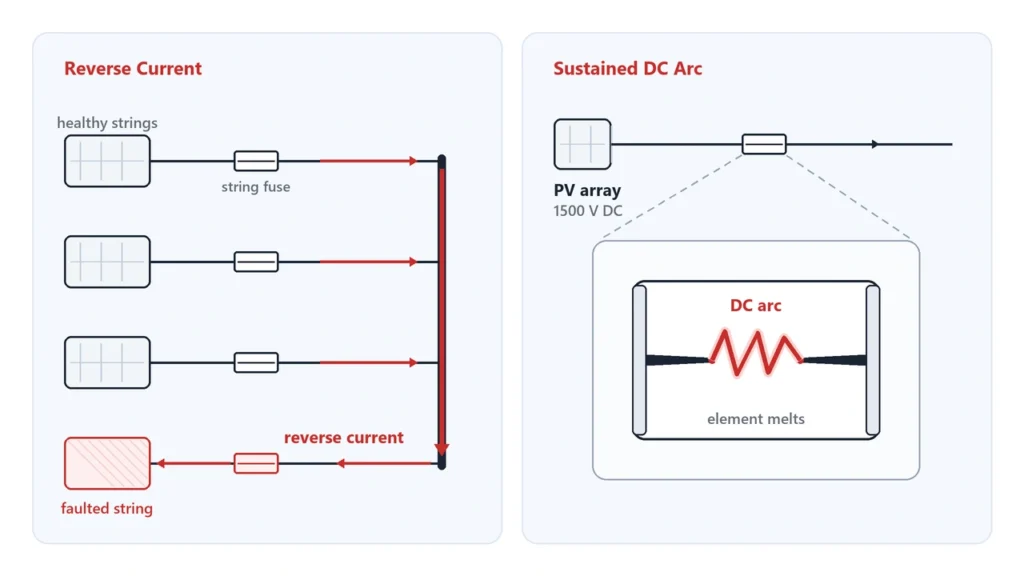
A particularly important PV fault condition occurs when several strings operate in parallel.
If one string develops a fault, healthy parallel strings can feed reverse current into the faulted string. The resulting current can exceed the level that the module or wiring is designed to withstand.
This is one of the principal reasons specialized PV fuse-links exist.
For a detailed explanation of reverse current and when string protection is required, see our Solar Panel Fuse Guide.
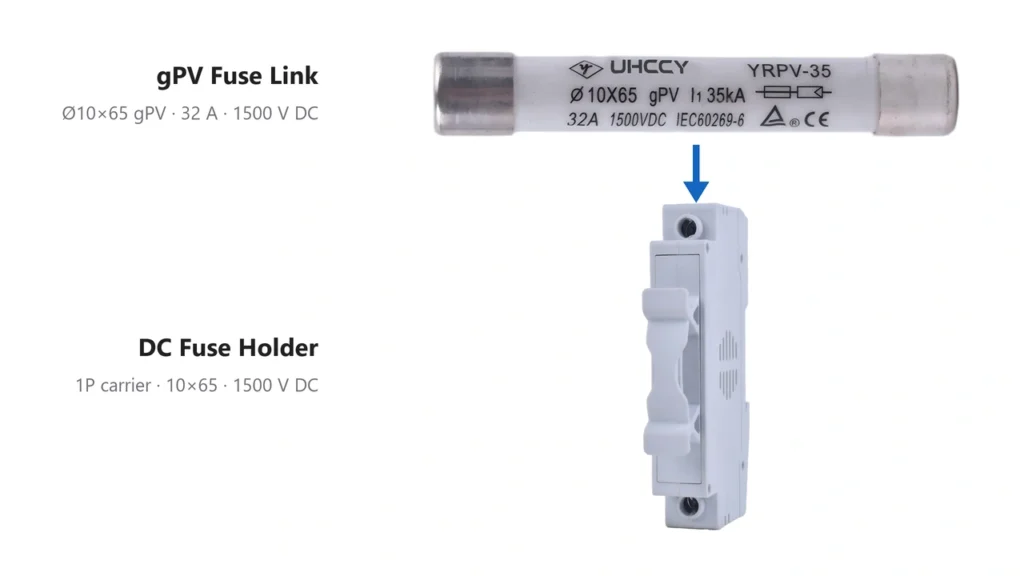
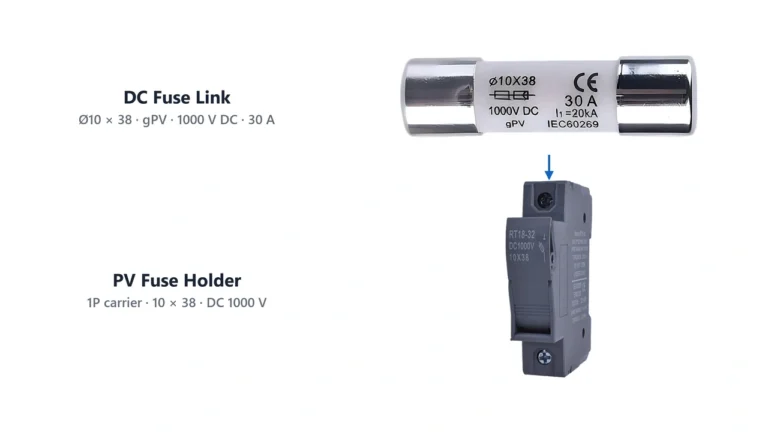
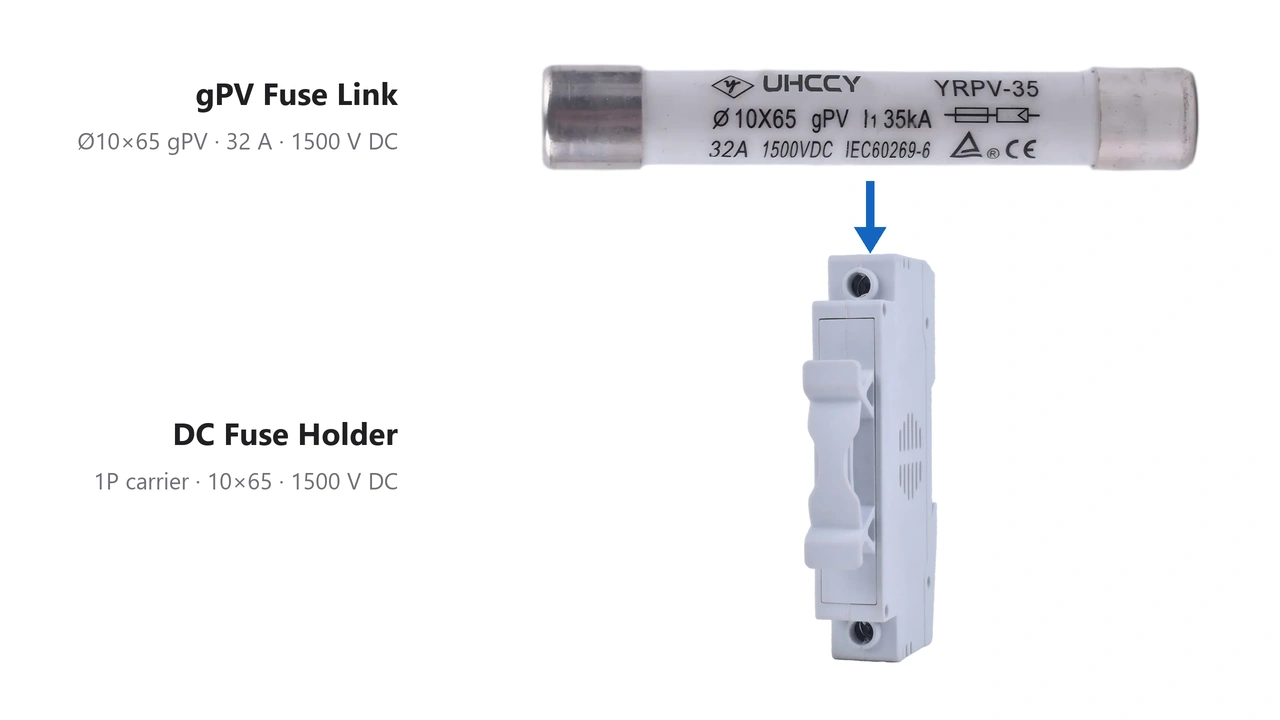
gPV fuse and photovoltaic fuse holder for solar PV protectionWhat Does gPV Mean in IEC 60269-6?
The designation can be understood in two parts:
g + PV
What Does “g” Mean?
Within IEC fuse terminology, the first letter describes the breaking range.
g identifies a full-range breaking-capacity fuse-link.
In practical terms, this means the fuse is intended to interrupt overcurrents across its defined operating range rather than only high short-circuit currents.
This matters in photovoltaic systems because dangerous PV faults do not always produce extremely high current.
What Does “PV” Mean?
PV identifies the photovoltaic utilization category.
Therefore:
gPV = full-range DC breaking capability intended for photovoltaic energy systems
IEC 60269-6 is the dedicated part of the IEC 60269 fuse series that adds the requirements for these photovoltaic fuse-links.
The currently valid consolidated IEC publication is:
IEC 60269-6:2010+A1:2021
It applies to fuse-links for protecting PV strings and PV arrays in circuits with nominal voltages up to 1500 V DC.
An important terminology point is:
gPV is a utilization category—not by itself proof of product certification.
Printing gPV on a product does not automatically demonstrate that the exact fuse has been independently tested or certified to IEC 60269-6.
For procurement, the corresponding certificate, declaration or test documentation should be verified when IEC compliance is required.
Why Do PV Systems Need gPV Fuses?
A conventional electrical protection system may have very high fault current available from a transformer or generator.
Photovoltaic strings behave differently.
PV modules are current-limited sources, so some fault conditions can produce currents that are only moderately above normal operating current.
At the same time, a PV system can remain energized whenever sufficient sunlight is available.
This creates an unusual protection problem:
relatively low fault current + sustained high DC voltage
A suitable PV fuse must therefore be capable of operating under fault conditions specific to photovoltaic arrays.
Eaton describes its photovoltaic gPV fuses as being specifically designed for low-fault-current conditions associated with PV systems while providing DC protection up to 1500 V depending on the fuse family.
Reverse Current Between Parallel Strings
Consider four parallel strings:
String A
String B
String C
String D
If String A develops a fault, Strings B, C and D can potentially feed current toward that fault.
The affected string may therefore experience substantially more current than it normally produces itself.
A correctly selected string fuse can isolate the faulted circuit before the reverse current exceeds the permitted limits of the module or conductor.
Sustained DC Arc Interruption
PV systems also operate at DC voltage.
Unlike AC, steady DC does not provide periodic natural current-zero crossings that assist arc extinction.
The fuse must therefore be specifically designed and rated to interrupt the relevant DC voltage.
For the underlying AC/DC interruption difference, see AC Fuse vs DC Fuse.
gPV fuse protection for reverse current and DC faults in photovoltaic systemsgPV Fuse vs General DC Fuse
A common mistake is assuming that every DC-rated fuse can be used as a photovoltaic fuse.
A DC voltage rating is necessary—but it is not the only requirement.
| Feature | General DC Fuse | gPV Fuse |
|---|---|---|
| DC voltage rating | May be available | Required |
| Designed specifically for PV | Not necessarily | Yes |
| PV utilization category | Not necessarily | gPV |
| Low PV fault-current performance | Depends on design | Specifically addressed |
| Parallel-string reverse-current protection | Not necessarily intended | Typical application |
| IEC 60269-6 | Not automatically | Relevant PV standard |
| PV string application | Must be verified | Intended application |
A fuse marked:
1000 V DC, 20 A
is therefore not automatically equivalent to:
1000 V DC, 20 A, gPV
Even if the dimensions are identical.
gPV vs gG
A gG fuse is a general-purpose full-range fuse category commonly associated with cable and general distribution protection.
A gPV fuse is specifically intended for photovoltaic applications.
They should not be treated as interchangeable simply because both begin with g.
gPV vs aR or gR
aR and gR fuse categories are associated with semiconductor protection.
Their time-current behavior and protection objectives differ from those of PV string fuses.
A semiconductor fuse therefore should not automatically replace a gPV fuse.
The utilization category is part of the protection specification—not merely a label.
How to Read a gPV Fuse Rating
A photovoltaic fuse specification contains several independent ratings.
For example, a fuse may be described as:
20 A / 1000 V DC / gPV / 10 × 38 mm
Each value means something different.
Rated Current
Example:
20 A
This identifies the fuse’s rated-current class and relates to its time-current characteristic.
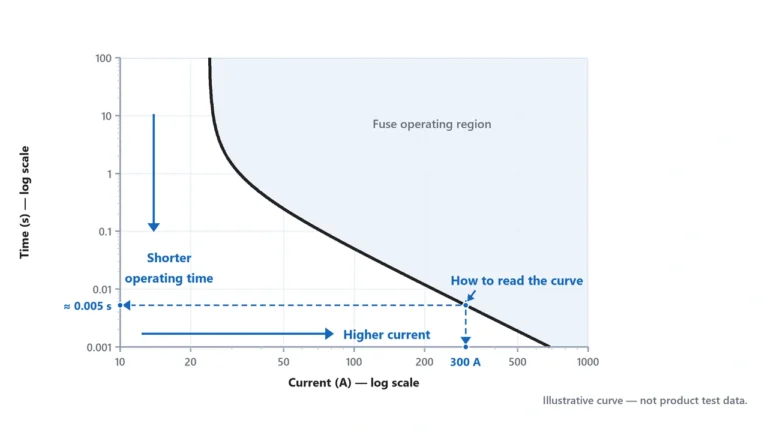
It does not mean the fuse opens instantly at 20.1 A.
Fuse operation depends on both:
current magnitude + time
For actual PV current calculations, see our Solar Fuse Sizing Guide.
Rated DC Voltage
Example:
1000 V DC
or:
1500 V DC
This rating indicates the maximum DC voltage for which the fuse has been designed and tested under its stated conditions.
The selected fuse must satisfy:
Fuse rated DC voltage ≥ maximum calculated circuit voltage
For PV strings, cold-temperature increases in module Voc must be considered.
Breaking Capacity
Breaking capacity defines the maximum prospective fault current the fuse can safely interrupt under its specified test conditions.
It is different from rated current.
A fuse rated:
20 A
can have a breaking capacity far higher than 20 A.
Never confuse:
current rating
with:
breaking capacity
Utilization Category
For a photovoltaic fuse:
gPV
identifies the application category.
Physical Size
Common PV fuse families can include formats such as:
- 10 × 38 mm;
- 14 × 51 mm;
- 14 × 65 mm;
- 10 × 85 mm;
- larger bolt-mounted or knife-blade formats.
Exact formats vary by manufacturer and electrical rating.
A physically compatible fuse should not automatically be treated as electrically compatible.
I²t and Power Loss
More detailed fuse specifications can also include:
- pre-arcing I²t;
- total clearing I²t;
- power loss;
- time-current curves;
- ambient-temperature correction data.
These values become important when coordinating the fuse with conductors, equipment and thermal conditions.
Where Are gPV Fuses Used?
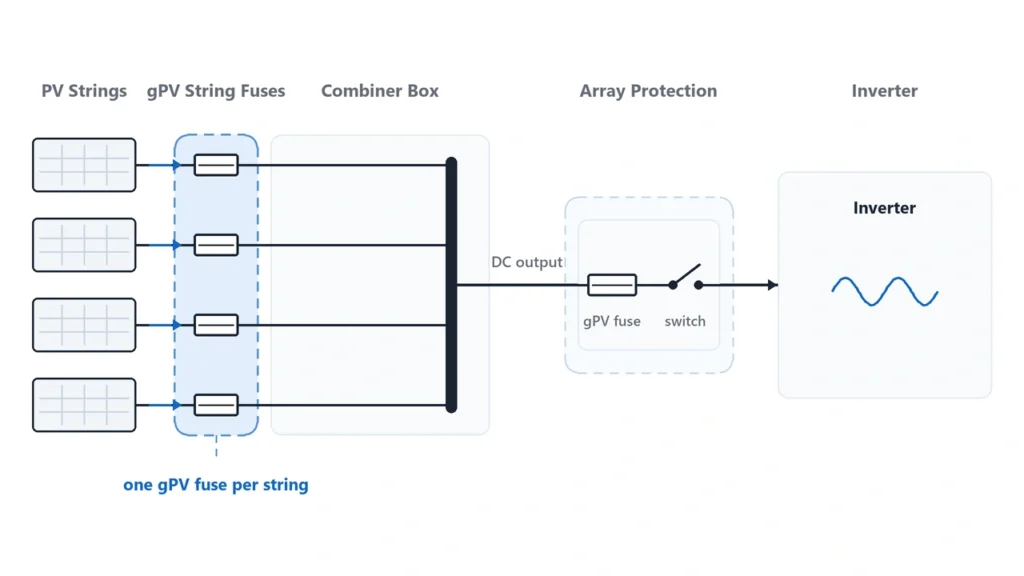
The most familiar application is individual PV string protection.
A typical arrangement is:
PV String 1 → gPV Fuse →
PV String 2 → gPV Fuse → Combiner Box → DC Output → Inverter
PV String 3 → gPV Fuse →
Each protected string can then be isolated from excessive reverse current from the remaining strings.
PV Combiner Boxes
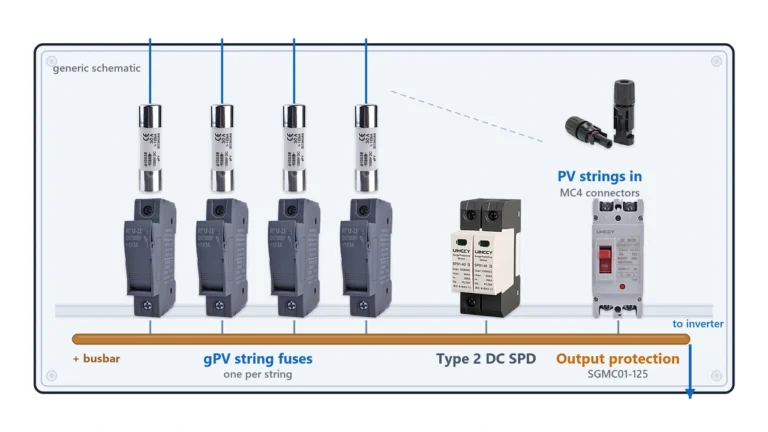
Combiner boxes are one of the most common locations for gPV fuse-links.
The protection system may include:
PV string → fuse-link → fuse holder → busbar → output protection
The fuse should not be selected independently from the holder and enclosure.
Temperature rise inside a combiner box can affect fuse and holder current capability.
Inline PV Fuse Assemblies
A gPV fuse may also be incorporated into an inline assembly.
In that case, the complete assembly must coordinate:
- fuse rating;
- holder or fuse body;
- cable;
- terminals;
- connectors;
- environmental protection;
- DC voltage rating.
An inline assembly should not be judged only by the fuse-link inside it.
Larger PV Array Circuits
Larger gPV fuse formats can also be used in higher-current PV array and recombiner applications.
This is why gPV does not identify one specific physical fuse size.
It identifies an application and breaking-range category.
gPV fuse locations in solar PV strings and combiner boxesHow to Select the Right gPV Fuse
Selecting a gPV fuse requires several limits to be satisfied simultaneously.
A practical sequence is:
1. Confirm That String Overcurrent Protection Is Required
Do not install a fuse purely because the system contains solar modules.
Determine whether parallel sources can create damaging reverse or fault current.
See Solar Panel Fuse Guide for this step.
2. Calculate the Required Current Rating
Use the actual module Isc and the protection method required by the governing electrical standard.
Do not select a fuse from panel wattage.
For detailed calculations, see Solar Fuse Sizing Guide.
3. Check the Module Maximum Series Fuse Rating
The selected fuse must not exceed the maximum overcurrent-protection value permitted by the module manufacturer.
This is an upper limit—not automatically the recommended fuse rating.
4. Verify Maximum DC Voltage
Calculate the highest possible string voltage, including cold-temperature effects.
Then confirm:
Fuse voltage rating ≥ maximum string voltage
5. Verify Breaking Capacity
The fuse must safely interrupt the prospective fault current available at its installation point.
6. Verify gPV Classification
For IEC photovoltaic applications, verify that the intended fuse-link has the appropriate gPV classification and supporting technical documentation.
7. Check Fuse Holder Compatibility
Confirm:
- dimensions;
- current rating;
- DC voltage;
- terminal size;
- temperature characteristics;
- installation method.
8. Check Ambient Temperature
PV combiner boxes can operate at significant internal temperatures.
Use the fuse and holder manufacturers’ derating information where applicable.
The result is not simply:
20 A fuse
but something closer to:
20 A / required DC voltage / gPV / required breaking capacity / correct physical format
IEC 60269-6, UL 248-19 and PV Fuse Compliance
For international projects, IEC 60269-6 is one of the central standards for photovoltaic fuse-links.
The current consolidated IEC edition is:
IEC 60269-6:2010+A1:2021
and covers protection of PV strings and arrays in circuits up to 1500 V DC.
For North American projects, UL 248-19 covers photovoltaic fuses intended for protection of PV strings, arrays and associated wiring. UL currently lists UL 248-19 as an active standard, with its latest revision dated November 25, 2024.
These standards should not be treated as interchangeable labels.
A product can be designed around IEC requirements, UL requirements or both, depending on the market and certification program.
For B2B procurement, distinguish between statements such as:
Designed according to IEC 60269-6
and:
IEC-certified / independently certified product
Only make a certification claim when documentation for the exact product configuration supports it.
The same rule applies to UL.
gPV Fuse Selection for Solar Projects
For an EPC contractor, distributor, panel builder or OEM project, a useful PV fuse inquiry should include more than the desired current rating.
Provide:
PV module model
→ Isc
→ Voc
→ maximum series fuse rating
→ modules per string
→ parallel strings
→ maximum system voltage
→ required fuse format
→ holder requirement
→ applicable IEC / UL requirements
This allows the supplier to evaluate the complete application instead of selecting a fuse from amperage alone.
A gPV fuse should ultimately be coordinated with:
module → conductor → fuse-link → fuse holder → combiner or enclosure → downstream DC protection
rather than treated as an isolated component.
For available UHCCY photovoltaic fuse-links and compatible fuse holders, see the DC Fuse range.
Where a project is also comparing fuses with resettable DC protection, see Fuse vs Circuit Breaker.