Table of Contents
Fuse vs circuit breaker is not simply a choice between a cheaper device and a resettable one. Both devices can protect electrical circuits against overcurrent, but they interrupt faults differently and offer different advantages in DC and solar PV systems.
A fuse operates by melting a calibrated element and must normally be replaced after operation. A circuit breaker uses a mechanical switching mechanism that trips when its protection threshold is reached and can normally be reset after the fault has been corrected.
For DC protection, the more important questions are:
What fault current must be interrupted? How quickly must fault energy be limited? Is manual switching required? Is resetability useful? What DC voltage and application class apply?
In many photovoltaic systems, the answer is not “fuse or breaker.” Both devices can be used at different points in the same system.
For the fundamentals of DC fuse voltage, current and breaking capacity, see our DC Fuse Guide.
Fuse vs Circuit Breaker: Key Differences
The basic differences can be summarized as follows:
| Feature | Fuse | Circuit Breaker |
|---|---|---|
| Operating principle | Fusible element melts | Mechanical trip mechanism opens contacts |
| After operation | Normally replaced | Normally resettable |
| Current limiting | Can be very effective with current-limiting fuse designs | Depends strongly on breaker design |
| Switching function | Normally no manual switching function | Often provides manual switching |
| Isolation capability | Requires appropriate fuse-disconnector or separate isolator | Some breakers are rated for isolation |
| Moving parts | None in basic fuse-link | Mechanical moving parts |
| Auxiliary functions | Limited | Can include auxiliary, shunt trip or signaling functions |
| Maintenance | Fuse-link itself has no mechanism to maintain | Mechanical breaker may require inspection or maintenance |
| Fault interruption | Can provide high breaking capacity in compact format | Depends on breaker interrupting rating |
| Reset after fault | No | Yes |
| Typical PV use | String and array protection | Array output, inverter input or DC distribution |
Eaton similarly notes that both fuses and circuit breakers are overcurrent protective devices, while fuses must be replaced after operation and circuit breakers can generally be reset. Eaton — Circuit Breaker Fundamentals
The important point is that neither technology is automatically superior.
The correct device depends on the circuit.
How a Fuse and Circuit Breaker Interrupt a Fault
Both devices aim to stop damaging overcurrent, but the physical interruption process is different.
How a Fuse Works
A fuse contains a calibrated conductive element.
When excessive current flows:
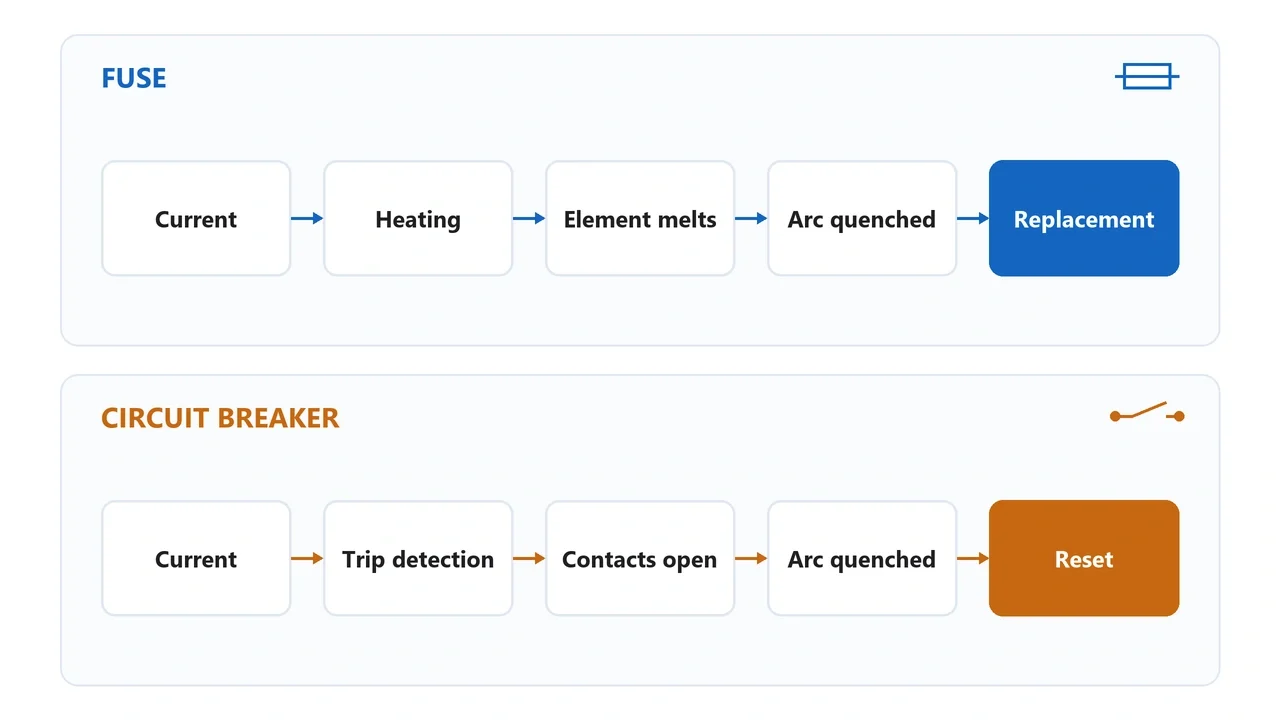
current increases → element heats → element melts → arc forms → arc is extinguished → circuit opens
The fuse element is intentionally destroyed during this process.
The fuse therefore has to be replaced after successful operation.
A properly selected current-limiting fuse can begin limiting a severe fault before the prospective fault current reaches its full peak.
This can reduce the electrical and thermal energy passed to downstream equipment.
However, this performance depends on:
- fuse type;
- current rating;
- fault-current magnitude;
- system voltage;
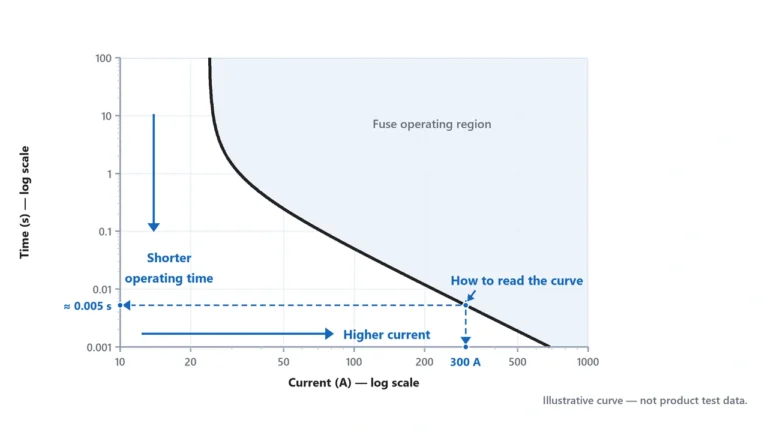
- time-current characteristic;
- I²t characteristics.
It should not be generalized to every fuse.
How a Circuit Breaker Works
A circuit breaker uses contacts and a mechanical trip mechanism.
A typical process is:
overcurrent detected → trip mechanism releases → contacts separate → arc forms → arc-extinguishing system interrupts current
After the fault has been investigated and cleared, the breaker can normally be reset.
Depending on the breaker design, tripping may be provided by:
- thermal elements;
- magnetic elements;
- electronic trip units;
- combinations of these technologies.
This gives circuit breakers functions that a basic fuse-link cannot provide.
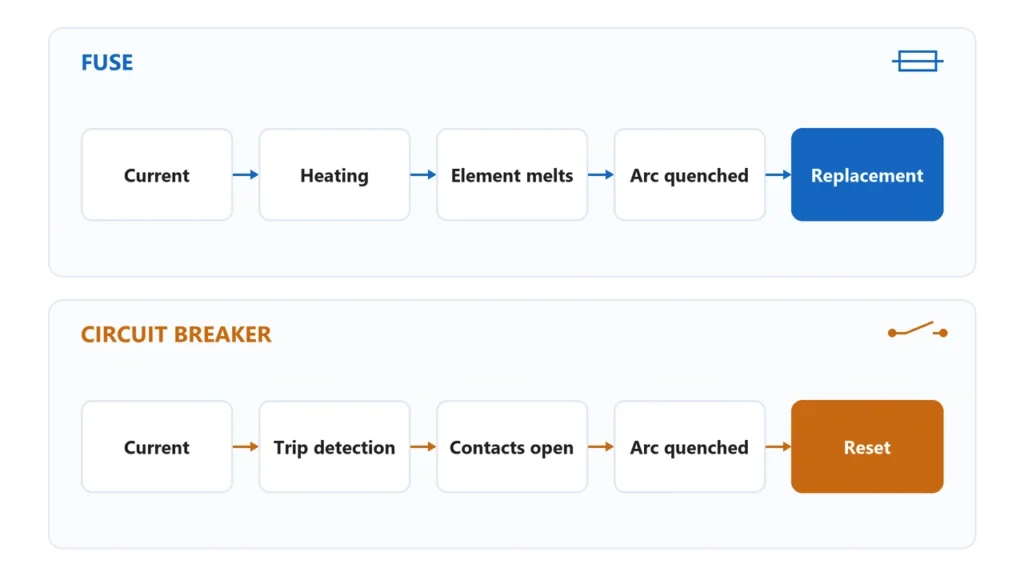
Fuse vs circuit breaker operating principle for DC protectionWhich Provides Better Short-Circuit Protection?
There is no universal answer.
The comparison depends on:
prospective fault current + protection-device characteristics + downstream equipment withstand capability
Advantages of Current-Limiting Fuses
A properly selected current-limiting fuse can provide very strong protection against high short-circuit currents.
During a severe fault, the fuse may limit:
- peak current;
- fault duration;
- I²t let-through energy.
This can reduce stress on:
- cables;
- busbars;
- terminals;
- semiconductor equipment;
- downstream protection devices.
This is one reason fuses remain widely used even though circuit breakers are resettable.
The current IEC general standard for enclosed current-limiting fuse-links is IEC 60269-1:2024. It covers fuse-links with rated breaking capacities of at least 6 kA for AC systems up to 1000 V and DC systems up to 1500 V. IEC 60269-1:2024 — Low-voltage fuses
That scope does not mean every fuse has the same breaking capacity.
Always check the actual product rating.
Advantages of Circuit Breakers
A correctly selected breaker also provides short-circuit protection.
Its major advantages can include:
- resetability;
- integrated switching;
- defined trip characteristics;
- auxiliary contacts;
- remote trip functions;
- adjustable trip settings on some breaker types.
Industrial circuit breakers are covered by standards including IEC 60947-2:2024, which applies to circuit breakers for circuits up to 1000 V AC or 1500 V DC. IEC 60947-2:2024 — Circuit-breakers
Again, this is the scope of the standard—not a claim that every breaker is suitable for 1500 V DC.
The actual breaker marking and datasheet determine its ratings.
Fuse vs Circuit Breaker for Solar PV Systems
Solar PV systems illustrate why fuse and circuit breaker should not always be treated as competing technologies.
A typical larger PV architecture may contain both.
For example:
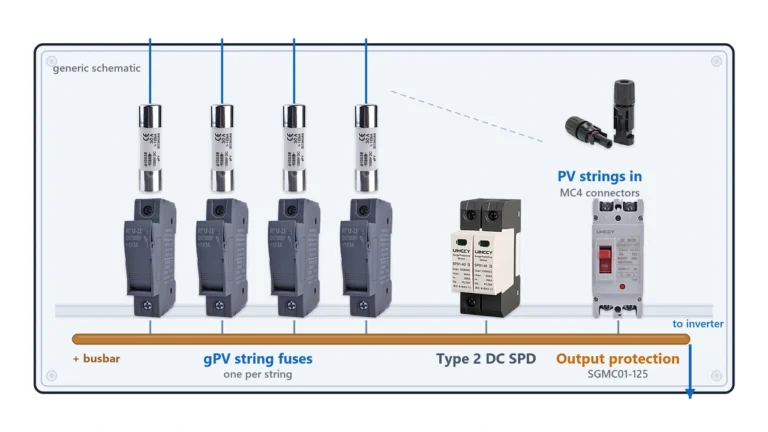
PV String → gPV Fuse → Combiner → DC Circuit Breaker / Disconnect → Inverter
The fuse and breaker are doing different jobs.
PV String Level
Individual PV strings are commonly protected with gPV fuse-links where overcurrent protection is required.
This is particularly relevant when multiple strings operate in parallel and healthy strings can feed reverse current into a faulted string.
A compact fuse is well suited to this role because multiple individual string protection devices may need to fit inside one combiner box.
For the conditions that determine whether string fusing is required, see our Solar Panel Fuse Guide.
PV Array or Combiner Output
After several strings are combined, the output circuit carries substantially more current.
Depending on the system architecture, protection may use:
- a suitable fuse;
- a DC circuit breaker;
- a fused disconnector;
- another correctly rated protection arrangement.
A DC breaker can be useful at this level when the project also benefits from a resettable switching device.
Inverter Input
Some systems include DC breakers or other switching devices near the inverter input.
However, a circuit breaker should not automatically be treated as a substitute for a dedicated isolator.
Whether a breaker is suitable for isolation depends on its design, standard, marking and installation requirements.
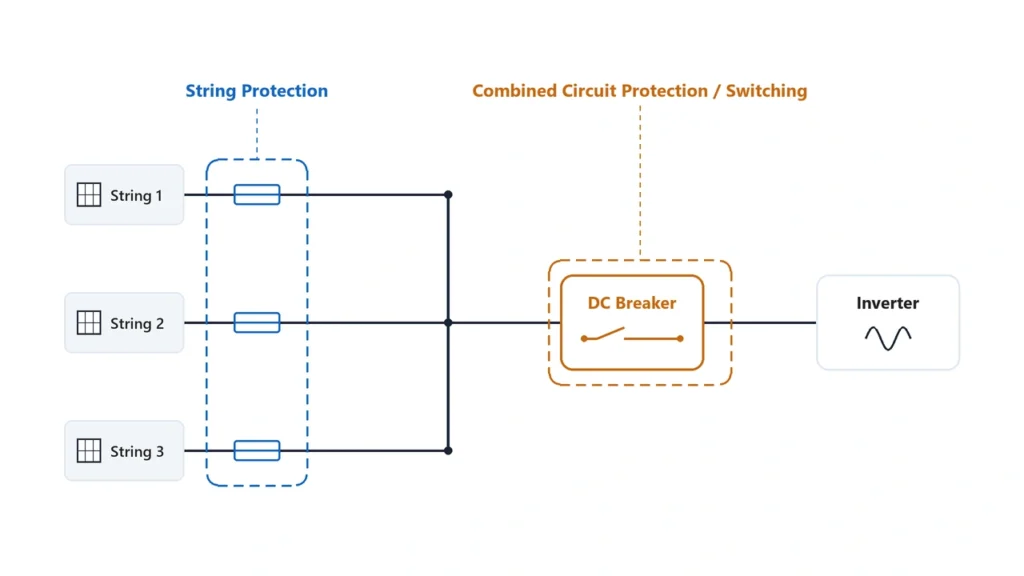
Solar fuse vs circuit breaker locations in a PV systemWhen Is a Fuse Better Than a Circuit Breaker?
A fuse can be particularly attractive when the design prioritizes:
High Fault-Current Interruption
Current-limiting fuse designs can provide strong limitation of high prospective short-circuit currents.
This can be important where reducing downstream let-through energy is a major protection objective.
Compact Protection
Fuse-links can provide substantial protection capability in a relatively compact package.
In PV combiner boxes, this is useful because many string protection devices may need to be installed side by side.
Simple Construction
A basic fuse-link contains no mechanical trip mechanism.
There are no springs, latches or trip linkages inside the fuse-link itself.
This simplicity eliminates mechanical reset mechanisms from the protective element.
Clear Fault Replacement
Once a fuse has operated, the fuse-link must normally be replaced.
This forces the circuit to remain open until someone physically accesses the equipment.
However, this should not be described as universally safer—it is simply a different operational characteristic.
PV String Protection
For individual photovoltaic strings, purpose-designed gPV fuse-links provide a widely used and standardized protection method.
If the fuse current still needs to be calculated, see our Solar Fuse Sizing Guide.
When Is a Circuit Breaker Better Than a Fuse?
Circuit breakers become attractive where the system benefits from functions beyond one-time overcurrent interruption.
Resettable Operation
After the cause of a fault has been identified and corrected, a breaker can normally be reset without replacing a fuse-link.
This can reduce replacement inventory and simplify restoration.
However:
resettable does not mean “reset immediately.”
A tripped breaker indicates that something caused the protection device to operate.
The fault should be identified before re-energizing the circuit.
Manual Switching
Many circuit breakers can also be operated manually.
This can simplify panel operation where switching is required in addition to overcurrent protection.
The exact device must still be checked for:
- switching duty;
- isolation capability;
- DC voltage;
- polarity;
- breaking capacity.
Auxiliary Functions
Depending on breaker type, options may include:
- auxiliary contacts;
- alarm contacts;
- shunt trip;
- undervoltage release;
- motorized operating mechanisms;
- remote monitoring.
These functions can be useful in larger industrial and PV distribution systems.
Adjustable Protection
Some industrial molded-case circuit breakers provide adjustable trip settings.
This can offer greater flexibility for coordination than a fixed fuse rating.
Small MCB-type devices, however, generally have fixed trip characteristics rather than continuously adjustable settings.
DC Fuse vs DC Circuit Breaker: Important Selection Checks
The comparison becomes more demanding in DC systems because arc extinction is harder than in AC circuits.
Regardless of whether a fuse or breaker is used, check the following parameters.
DC Voltage Rating
The device must be explicitly rated for the maximum DC system voltage.
Do not use an AC rating as a substitute for a DC rating.
Breaking Capacity
The device must safely interrupt the prospective fault current.
For a fuse, this may be specified as breaking capacity.
For a circuit breaker, ratings may be expressed through values such as rated ultimate short-circuit breaking capacity or other standard-specific interrupting ratings.
Do not compare different rating systems without understanding what each value represents.
Number of Poles
High-voltage DC breakers may require multiple poles to be connected in series to achieve a particular DC voltage rating.
The manufacturer’s required wiring arrangement must be followed.
Never assume:
one 250 V pole × four poles = any arbitrary 1000 V DC application
unless that configuration is explicitly specified and tested by the manufacturer.
Polarity
Some DC breakers are polarity-sensitive.
Others are designed as non-polarized devices.
Incorrectly wiring a polarity-sensitive breaker can affect its ability to interrupt a DC fault safely.
The manufacturer’s circuit diagram takes priority.
Current Rating
Both devices must coordinate with:
- conductor ampacity;
- normal operating current;
- equipment limits;
- environmental derating.
Temperature
Both fuses and circuit breakers can be affected by ambient temperature.
This is particularly relevant inside outdoor PV enclosures.
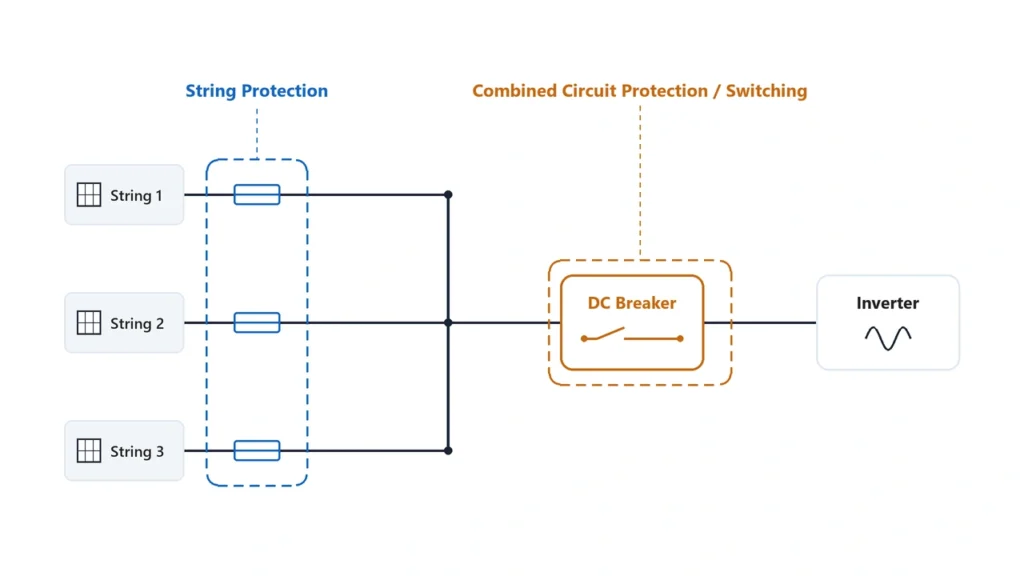
DC fuse vs circuit breaker selection checklistFuse or Circuit Breaker: Which Should You Choose?
Do not make the decision from one feature such as resetability.
Start with the protection function.
| Design Requirement | Fuse May Be Preferred | Circuit Breaker May Be Preferred |
|---|---|---|
| Compact string protection | ✓ | |
| High current-limiting performance | ✓ | Depends on design |
| Reset after operation | ✓ | |
| Manual switching | ✓ | |
| Auxiliary contacts | ✓ | |
| Remote trip capability | ✓ | |
| Simple protective element | ✓ | |
| Adjustable trip settings | Some types | |
| gPV string protection | ✓ | |
| Repeated operational switching | ✓ | |
| High-density combiner box | ✓ | Depends on design |
This is not a universal selection table.
Individual products can have capabilities that differ significantly from the typical characteristics above.
For photovoltaic systems, a common engineering approach is:
Use the device that best matches the protection function at that point in the system.
That may result in:
gPV fuses at string level
combined with:
DC breakers or disconnecting devices at higher-current distribution levels
rather than forcing one technology to perform every protection and switching function.
Can a Circuit Breaker Replace a Solar Fuse?
Sometimes—but not simply because the breaker has the same ampere rating.
For example:
15 A gPV fuse
and:
15 A DC circuit breaker
are not automatically equivalent protection devices.
They can have different:
- time-current characteristics;
- current-limiting behavior;
- breaking capacities;
- voltage ratings;
- temperature characteristics;
- application standards;
- fault-response behavior.
A replacement requires the protection design to be reassessed.
The same applies in the opposite direction.
A fuse should not automatically replace a breaker when the breaker is also providing:
- switching;
- isolation;
- remote operation;
- signaling;
- system coordination.
The function of the original device must first be understood.
Fuse vs Circuit Breaker Cost
A basic fuse-link is often less expensive than an equivalent circuit breaker.
But comparing component purchase price alone can be misleading.
A fuse installation may also require:
- fuse holder;
- fuse disconnector;
- spare fuse inventory;
- service access after operation.
A breaker may have:
- higher initial purchase cost;
- larger physical size;
- greater mechanical complexity.
But it can normally be reset after a legitimate fault has been cleared.
The better comparison is therefore:
total protection-system cost
rather than:
fuse price vs breaker price
For B2B PV projects, enclosure dimensions, installation labor, service strategy and spare-parts requirements can matter as much as the protective-device unit price.
Selecting Protection for a DC or Solar Project
For a practical DC protection specification, determine:
Circuit type
→ PV string / PV array / battery / DC distribution
Maximum DC voltage
→ including applicable voltage variation
Normal current
→ including required continuous-current margins
Prospective fault current
Required breaking capacity
Protection characteristic
→ fuse curve / breaker trip characteristic
Switching requirement
Isolation requirement
Available enclosure space
Maintenance strategy
Applicable standards and certification requirements
For photovoltaic string applications, start with the Solar Panel Fuse Guide to determine whether string protection is required, then use the Solar Fuse Sizing Guide to determine the appropriate fuse-current range.
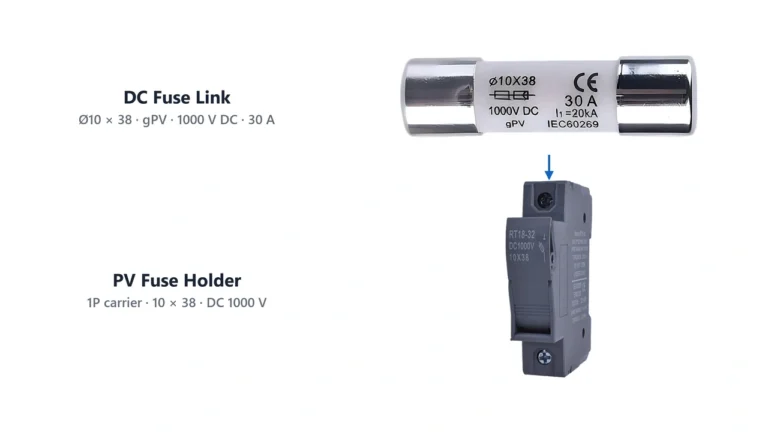
Available photovoltaic fuse-links and matching holders can be reviewed in the UHCCY DC Fuse range.
The correct choice is not universally “fuse” or “circuit breaker.”
In a properly coordinated DC system, each device should be selected according to the fault it must interrupt, the equipment it must protect and the operational function it must provide.