Table of Contents
The main difference in AC fuse vs DC fuse protection is not simply the current rating printed on the fuse. The critical difference is what happens after the fuse element melts and an electrical arc forms.
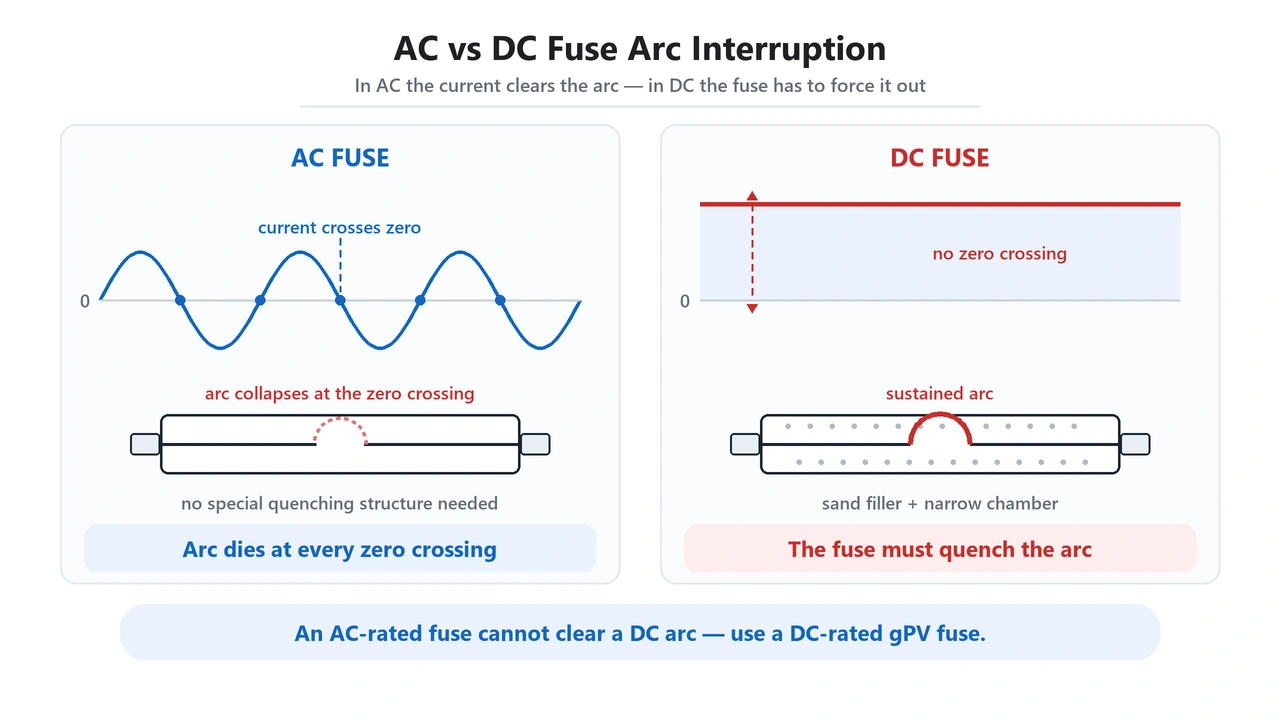
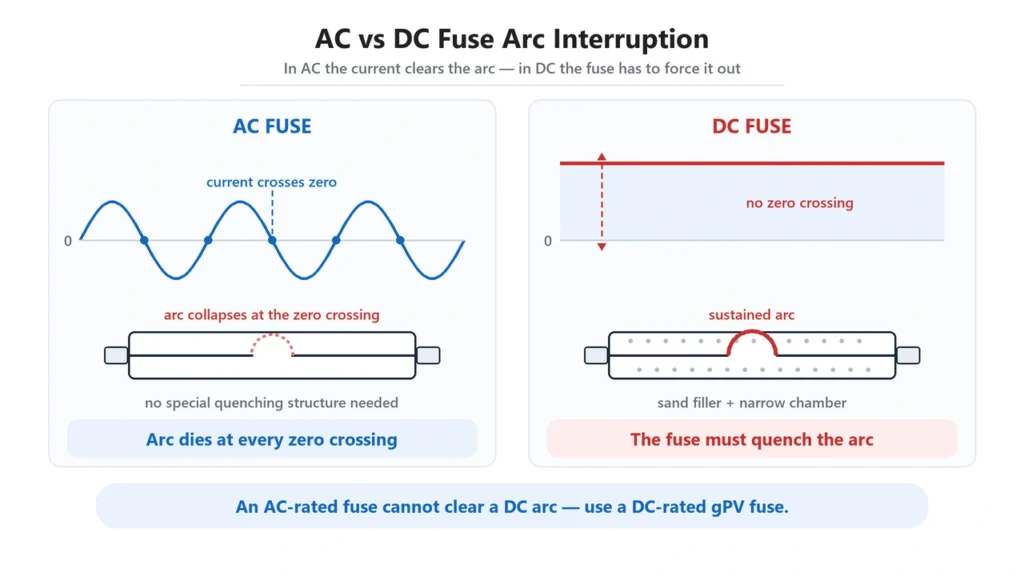
Alternating current naturally passes through zero every half-cycle, which helps extinguish an arc. Direct current does not have this natural current-zero point, so the fuse must interrupt a sustained DC arc using its own internal construction.
For this reason, an AC-only fuse should not be assumed safe for a DC circuit even when the ampere rating is identical.
The practical rule is:
Use a fuse only at an AC or DC voltage for which the manufacturer has explicitly rated it.
If you need a broader explanation of fuse current ratings, breaking capacity and DC protection principles, see our DC Fuse Guide.
AC Fuse vs DC Fuse at a Glance
| Feature | AC Fuse | DC Fuse |
|---|---|---|
| Current direction | Alternates direction | Flows primarily in one direction |
| Natural current zero | Yes | No periodic natural zero |
| Arc interruption | Generally easier | More difficult |
| Voltage rating | Specified AC rating | Specified DC rating |
| Internal arc control | Designed for rated AC duty | Designed for rated DC duty |
| Interchangeable? | Only with explicit DC rating | Only within manufacturer’s stated AC/DC ratings |
| Typical applications | AC distribution, motors, equipment | PV systems, batteries, DC distribution, EV systems |
A fuse may also carry both AC and DC ratings.
For example, a manufacturer might specify different maximum voltage or interrupting ratings for AC and DC operation on the same fuse family.
The marking and datasheet—not the physical appearance—determine where the fuse can safely be used.
Why Are AC and DC Fuses Different?
The fuse element itself responds primarily to current and heat.
When excessive current flows, electrical losses heat the fuse element until it melts.
The major AC/DC difference appears immediately afterward.
Once the fuse element separates, the circuit current does not always stop instantly. An electrical arc can form across the opening.
The fuse must extinguish this arc before the fault is safely interrupted.
This is where AC and DC behave differently.
Eaton’s fuse technical guidance explains that AC voltage and current repeatedly pass through zero, making fault interruption easier than in DC circuits where current continues in the same direction.
AC Circuit
For a 50 Hz AC system, the current crosses zero twice during each electrical cycle.
That means:
100 natural current-zero crossings per second
For a 60 Hz system:
120 zero crossings per second
These natural current-zero points help the arc lose energy and extinguish.
DC Circuit
DC does not periodically cross zero during normal steady-state operation.
After the fuse element melts, the voltage source can therefore continue sustaining the arc.
The fuse must create conditions that force the arc to extinguish.
This difference is why DC voltage ratings must be treated seriously.
AC fuse vs DC fuse arc interruption differenceWhy Is a DC Arc Harder to Extinguish?
An electrical arc is an ionized conductive path between separated contacts or fuse-element sections.
Once established, it can continue carrying current even though the metallic element has physically melted apart.
In AC:
Current falls toward zero → arc energy decreases → dielectric strength recovers → arc extinguishes
In DC:
Current continues → arc remains energized → fuse must lengthen, cool and deionize the arc
High-voltage DC fuses therefore often use design features intended to control the arc after melting.
Depending on fuse type, these may include:
- multiple fuse-element restrictions;
- longer internal arc paths;
- ceramic bodies;
- arc-quenching filler such as silica-based material;
- multiple melting points;
- larger physical dimensions.
This does not mean every DC fuse has the same internal design. Construction depends on voltage, current, breaking capacity and application.
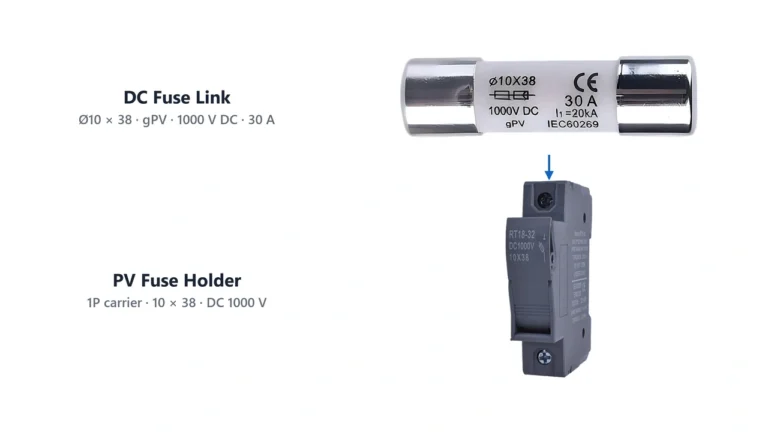
For photovoltaic systems, the additional operating requirements are addressed by dedicated gPV fuse designs. See our Solar Panel Fuse Guide for why PV strings require specialized protection.
Can an AC Fuse Be Used for DC?
Only if the fuse manufacturer explicitly provides a suitable DC rating.
Do not assume that:
250 V AC = 250 V DC
or that:
600 V AC fuse = safe at 600 V DC
The same physical fuse can sometimes have both AC and DC ratings, but the permitted voltage or breaking capacity may differ.
For example, a fuse could theoretically be specified by its manufacturer for:
690 V AC
but only:
500 V DC
The exact values depend on the particular product.
A fuse marked only for AC use should therefore not be installed in a DC circuit merely because:
- the current rating matches;
- the physical dimensions match;
- the fuse holder accepts it;
- the circuit voltage appears lower than its AC rating.
Littelfuse’s current Fuse Fundamentals guidance specifically states that fuses used in DC circuits must be rated for DC applications and warns against using an AC-only fuse in a DC circuit.
Can a DC Fuse Be Used for AC?
The same principle applies in the opposite direction.
Do not assume a DC-rated fuse can automatically be used on AC.
If the manufacturer’s datasheet lists both:
AC voltage rating
and:
DC voltage rating
then the fuse may be used within the specified conditions for each system.
If the product is specified only for DC duty, the AC application should not be inferred independently.
The important question is not:
Is DC harder to interrupt than AC?
and therefore:
Shouldn’t every DC fuse automatically work on AC?
That reasoning ignores certification, test conditions, time-current characteristics, breaking capacity and the manufacturer’s intended application.
Use the fuse according to its published rating.
Does Fuse Current Rating Change Between AC and DC?
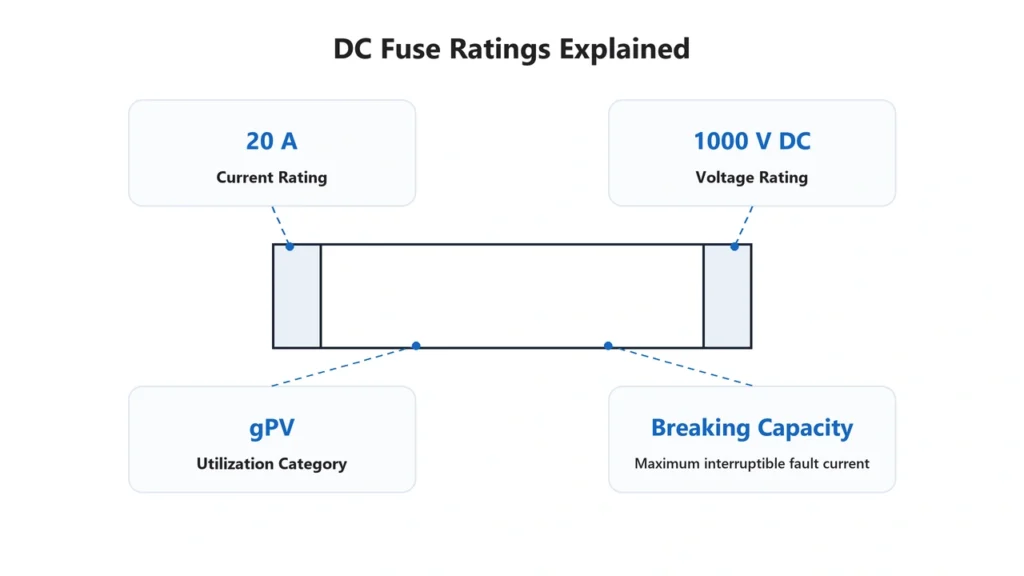
A fuse’s ampere rating and voltage rating describe different properties.
Current Rating
The current rating relates primarily to the fuse’s ability to carry current and its thermal operating characteristic.
For example:
20 A
describes the fuse’s nominal current rating.
Voltage Rating
The voltage rating determines the maximum circuit voltage at which the fuse has been designed to safely interrupt a fault under its specified conditions.
For example:
20 A, 1000 V DC
means something very different from simply:
20 A fuse
The current rating tells you approximately what current class the fuse belongs to.
The voltage rating tells you whether the fuse can safely complete the interruption after the element melts.
That distinction is particularly important in high-voltage DC systems.
Does a Fuse Blow at Its Rated Current?
Not necessarily.
A fuse marked:
20 A
does not mean it must open immediately at 20.1 A.
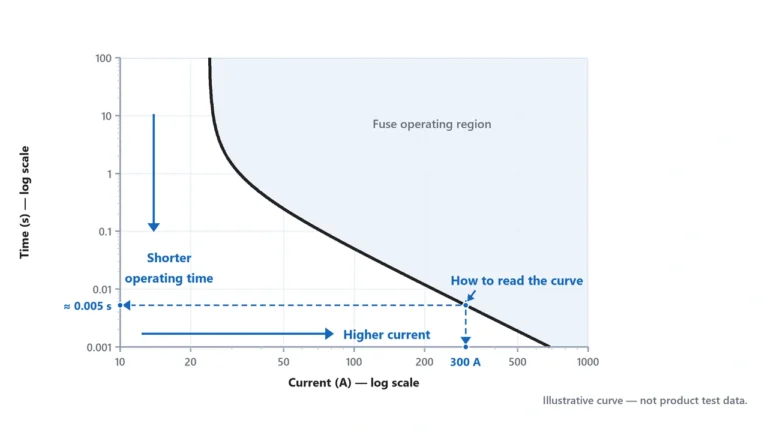
Fuses have time-current characteristics.
A relatively small overload may take much longer to operate than a severe fault.
As fault current increases, fuse operating time generally decreases.
The exact behavior depends on the fuse design and utilization category.
This is why two fuses with the same:
20 A
rating can still behave differently.
The complete fuse specification may include:
current rating + voltage rating + utilization category + time-current characteristic + breaking capacity + I²t
For PV applications, current sizing is discussed separately in our Solar Fuse Sizing Guide.
AC vs DC Fuse Voltage Ratings
Voltage rating is one of the most important differences between AC and DC fuse applications.
The latest general IEC low-voltage fuse standard, IEC 60269-1:2024, covers enclosed current-limiting fuse-links for power-frequency AC systems up to 1000 V and DC circuits up to 1500 V.
This does not mean every IEC 60269 fuse is suitable for:
1000 V AC
or:
1500 V DC
Those are the scope limits of the standard.
Each individual fuse still has its own rated voltage.
For example, actual products may be designed for:
- 250 V DC;
- 500 V DC;
- 600 V DC;
- 1000 V DC;
- 1500 V DC.
The correct requirement is always:
Fuse rated voltage ≥ maximum circuit voltage
using the correct AC or DC rating.
Why Can’t You Convert AC Fuse Voltage to DC Voltage?
There is no universal equation such as:
AC fuse voltage × conversion factor = DC fuse voltage
The interrupting capability depends on the actual fuse construction and testing.
Factors can include:
- arc length;
- fuse body length;
- number and geometry of element restrictions;
- arc-quenching material;
- recovery voltage;
- fault-current magnitude;
- circuit time constant;
- physical spacing;
- fuse class.
Therefore, search queries such as:
AC to DC fuse conversion
should not be answered with a generic voltage multiplier.
The correct procedure is:
Check the fuse manufacturer’s AC and DC ratings.
If no DC rating is provided, do not invent one.
Breaking Capacity: AC and DC Ratings May Differ
Breaking capacity, also called interrupting rating, describes the maximum prospective fault current that the fuse can safely interrupt under specified conditions.
It is not the same as rated current.
For example:
Rated current = 20 A
does not imply:
Breaking capacity = 20 A
The fuse may be designed to safely interrupt fault currents many orders of magnitude higher than its nominal operating current.
AC and DC breaking capabilities can differ because interrupting a DC arc is generally more demanding.
Therefore, when comparing AC fuse vs DC fuse specifications, check both:
Voltage rating
and:
Breaking capacity
for the actual current type.
Never assume an AC breaking-capacity value also applies to DC unless the manufacturer states it.
DC fuse current voltage and breaking capacity ratingsAre AC and DC Fuses Physically Different?
Sometimes yes, but appearance is not a reliable selection method.
Depending on the voltage and application, a DC fuse may need a longer body or different internal construction to provide sufficient arc-control capability.
However, two fuses can look almost identical while having very different:
- voltage ratings;
- breaking capacities;
- fuse classes;
- time-current characteristics;
- AC/DC approvals.
The opposite is also possible: one fuse family may carry both AC and DC ratings.
Therefore:
Never identify AC or DC suitability from fuse dimensions or appearance alone.
Read the marking and datasheet.
Are DC Fuses Polarized?
Many conventional fuse-links do not have positive and negative polarity in the same way that some semiconductor devices do.
Current can physically pass through the fusible element in either direction.
However, this should not be converted into a universal statement that every DC fuse assembly can be installed in either direction.
Some products or complete assemblies may have:
- indication circuits;
- auxiliary contacts;
- specified line/load orientation;
- integrated disconnect functions;
- application-specific installation requirements.
Follow the manufacturer’s installation instructions for the actual fuse and holder.
DC Fuse Applications
DC-rated fuses are used in many different electrical systems.
Typical examples include:
| Application | Typical Protection Requirement |
|---|---|
| Solar PV | gPV string and array protection |
| Battery systems | High available fault-current protection |
| EV systems | High-voltage DC battery protection |
| DC distribution | Feeder and branch protection |
| Industrial DC control | Equipment and conductor protection |
| Telecom systems | DC power distribution protection |
These applications should not all use the same fuse simply because they are DC.
A photovoltaic string fuse and a battery fuse may have very different operating requirements.
For UHCCY photovoltaic protection options, see the DC Fuse range.
Why Solar PV Makes the AC vs DC Difference Important
Modern photovoltaic strings can operate at:
1000 V DC
or:
1500 V DC
At these voltage levels, proper DC arc interruption is critical.
PV systems also present other characteristics such as:
- long periods of energized DC operation;
- outdoor temperature variation;
- relatively low string fault currents;
- reverse current from parallel strings;
- multiple interconnected current sources.
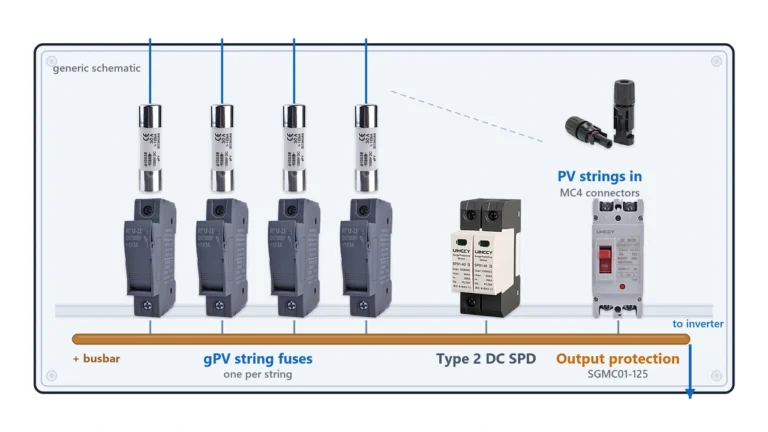
That is why photovoltaic fuse-links use specialized designs and gPV utilization categories rather than simply using an AC cartridge fuse of similar dimensions.
If you are selecting protection for parallel PV strings, read Solar Panel Fuse Guide first.
If the protection requirement has already been established and you need to calculate the actual current rating, continue to Solar Fuse Sizing Guide.
What Happens If an AC-Only Fuse Is Used on DC?
The fuse element may still melt when excessive current flows.
That does not prove the fuse is safe.
The dangerous stage occurs after melting.
If the fuse cannot interrupt the sustained DC arc, possible consequences can include:
continued arcing → excessive heating → fuse damage → holder damage → failure to interrupt the fault
The exact failure mode depends on circuit voltage, available fault current, fuse construction and installation.
This is why successful operation at low current or during a previous fault is not evidence that an AC-only fuse is suitable for DC use.
The product must have an appropriate DC rating.
How to Select Between an AC Fuse and DC Fuse
Do not start with physical size.
Start with the electrical system.
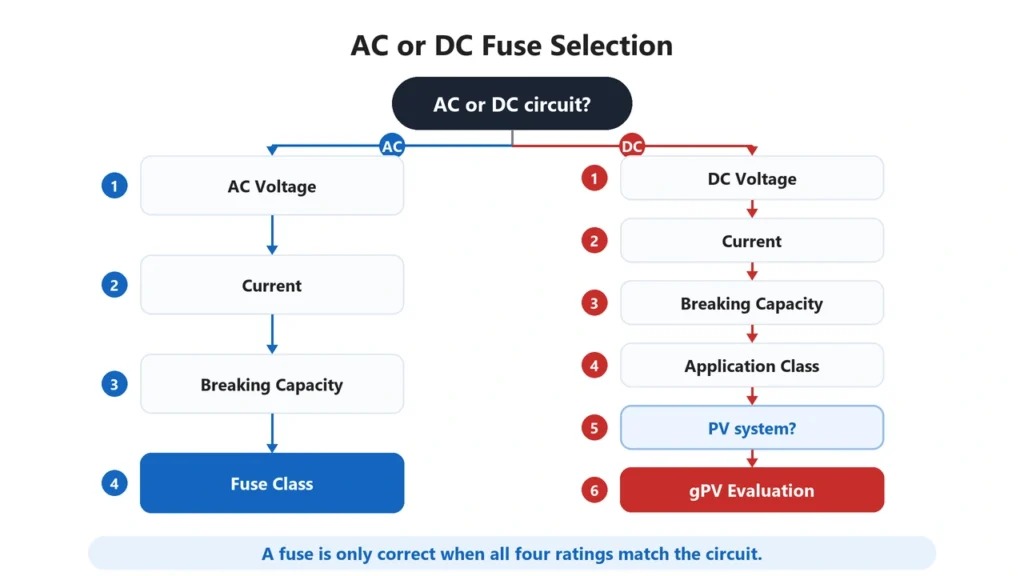
Use the following selection sequence:
1. Identify current type
AC or DC?
↓
2. Determine maximum circuit voltage
Use actual maximum operating voltage, not only nominal voltage.
↓
3. Determine required current rating
According to load, conductor and protection requirements.
↓
4. Determine prospective fault current
Verify the required breaking capacity.
↓
5. Select the correct fuse class
Examples can include gG, aM, gR, aR or gPV depending on the application.
↓
6. Verify AC/DC rating
The manufacturer’s datasheet must explicitly support the intended current type and voltage.
↓
7. Verify holder compatibility
Check dimensions, voltage, current and installation conditions.
For a DC photovoltaic application, this process can continue through the detailed selection criteria in our DC Fuse Guide.
AC fuse vs DC fuse selection flowchartAC Fuse vs DC Fuse: The Practical Rule
The key difference between AC and DC fuses is not that one fuse element melts and the other does not.
Both rely on a controlled fusible element.
The major difference is the interruption environment after the element melts.
AC provides regular natural current-zero crossings.
DC does not.
That difference affects the fuse’s ability to extinguish the arc, which in turn affects voltage rating, breaking capacity, internal construction and testing.
Therefore:
Never replace an AC fuse with a DC fuse, or a DC fuse with an AC fuse, based only on matching amperage and dimensions.
Check the manufacturer’s explicit rating for:
current type → voltage → current → breaking capacity → fuse class → holder compatibility
For photovoltaic systems, continue with our Solar Panel Fuse Guide and Solar Fuse Sizing Guide, or compare available gPV fuse links and holders in the DC Fuse category.