Table of Contents
A 1000V solar fuse and a 1500V solar fuse can have the same ampere rating while being designed for very different photovoltaic system voltages. The correct choice depends primarily on the maximum DC voltage that can actually appear in the PV string, not simply the nominal voltage printed on the inverter or project specification.
The key rule is:
PV fuse rated voltage ≥ maximum calculated DC circuit voltage
For solar arrays, that maximum voltage must include the increase in module open-circuit voltage (Voc) that occurs at low temperature.
This is why a string that appears to operate comfortably below 1000 V under standard test conditions can still require a higher voltage-class protection device under cold-weather conditions.
Voltage rating is also only one part of the specification. Current rating, gPV classification, breaking capacity, physical fuse size and fuse-holder compatibility must all match the application.
For the overall principles behind PV fuse selection, see our DC Fuse Guide.
1000V vs 1500V Solar Fuse: Key Differences
The primary difference is the maximum DC voltage that the fuse is designed to safely interrupt.
| Parameter | 1000V Solar Fuse | 1500V Solar Fuse |
|---|---|---|
| Rated voltage | Up to specified 1000 V DC duty | Up to specified 1500 V DC duty |
| Typical application | 1000 V-class PV arrays | 1500 V-class PV arrays |
| Arc interruption requirement | High-voltage DC | More demanding higher-voltage DC |
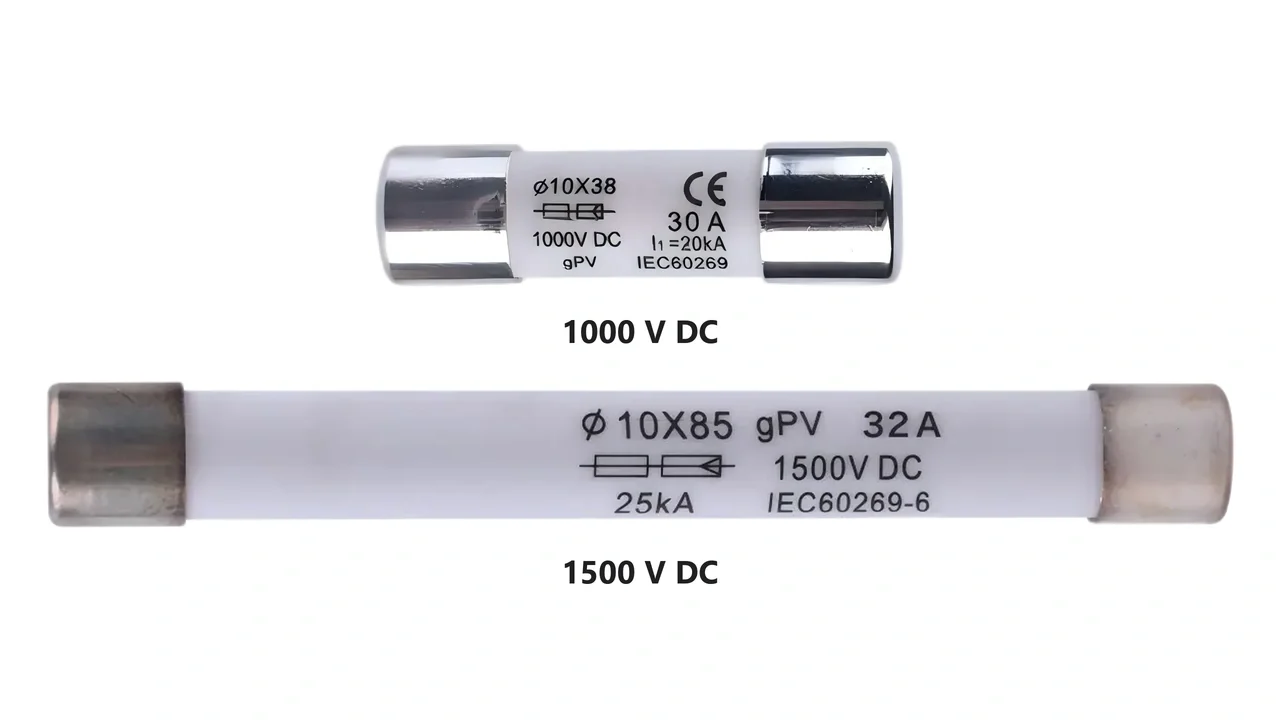
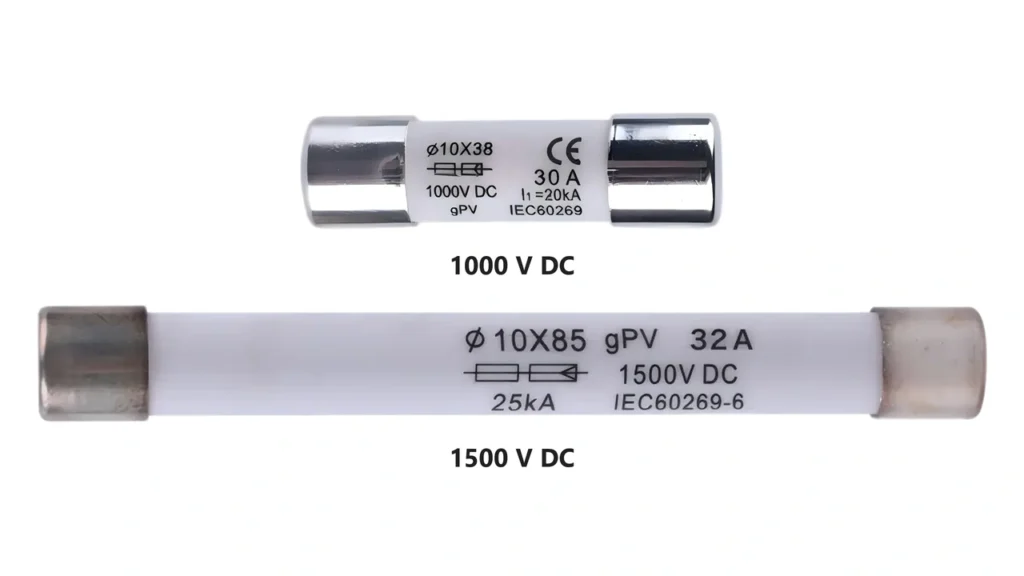
| Physical fuse format | Often compact formats such as 10 × 38 mm | Often longer formats such as 10 × 85 mm |
| Fuse holder | Must be rated for 1000 V DC | Must be rated for 1500 V DC |
| Current rating | Independent parameter | Independent parameter |
| PV class | gPV where applicable | gPV where applicable |
| Interchangeable? | Not automatically | Not automatically |
The dimensions shown above are industry examples, not universal rules.
For example, Eaton currently offers 1000 V DC gPV fuse-links in a 10 × 38 mm format and 1500 V DC PV fuse families in a longer 10 × 85 mm format.
This illustrates an important point:
Increasing fuse voltage capability often changes the complete fuse-and-holder platform, not only the number printed on the fuse.
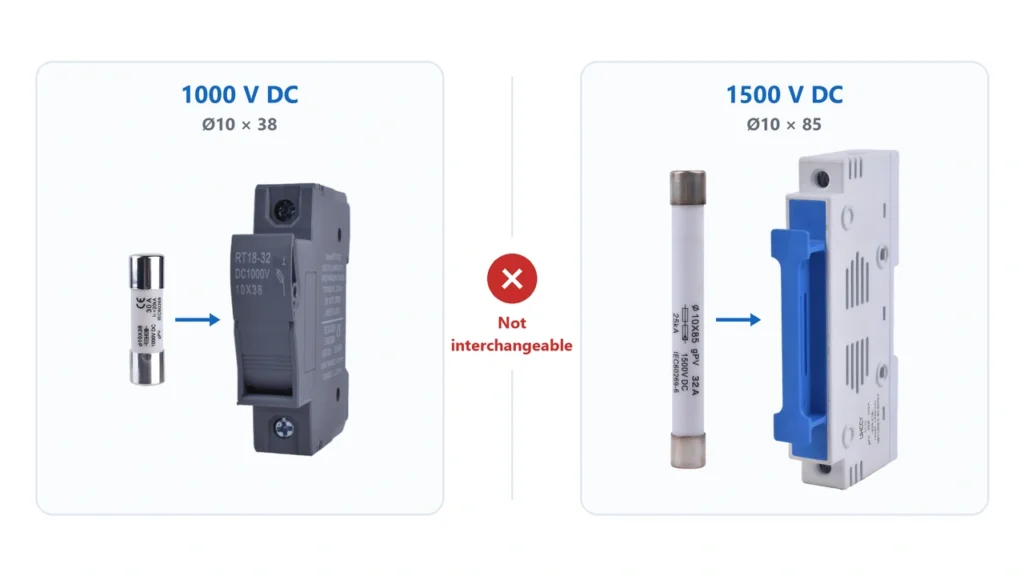
A 1500 V fuse should therefore not be treated as a drop-in upgrade for a 1000 V fuse.
IEC 60269-6 covers photovoltaic fuse-links for PV strings and arrays with nominal circuit voltages up to 1500 V DC.
1000V solar fuse vs 1500V PV fuse comparisonWhat Does the Voltage Rating on a PV Fuse Mean?
The voltage rating is not the voltage required to make the fuse operate.
It represents the maximum circuit voltage under which the fuse has been designed to safely interrupt a fault according to its specified conditions.
For example:
15 A / 1000 V DC / gPV
contains three different pieces of information:
15 A
→ rated current
1000 V DC
→ maximum stated DC voltage rating
gPV
→ photovoltaic utilization category
These parameters perform different functions.
Current Rating
The ampere rating relates to the fuse’s current-carrying and time-current characteristics.
Voltage Rating
The voltage rating relates to the fuse’s ability to complete interruption after its element melts.
When a fuse opens under DC voltage, an electrical arc forms between the separated portions of the fuse element.
Higher voltage makes arc extinction more demanding.
This is especially important because DC does not provide the regular current-zero crossings found in AC systems.
For a more detailed explanation of this mechanism, see AC Fuse vs DC Fuse.
Breaking Capacity
Breaking capacity specifies the maximum prospective fault current the fuse can safely interrupt under its stated test conditions.
It is separate from both voltage and normal ampere rating.
The complete selection therefore looks more like:
Voltage + Current + gPV Classification + Breaking Capacity + Physical Format
rather than simply:
1000 V or 1500 V
How to Determine the Required Solar Fuse Voltage
Do not select fuse voltage from the inverter’s nominal operating voltage alone.
The important value is the maximum possible PV string voltage.
The basic starting point is:
String Voc at STC = Module Voc × Modules in Series
Suppose a PV module has:
Voc = 49.5 V
and a string contains:
18 modules
At standard test conditions:
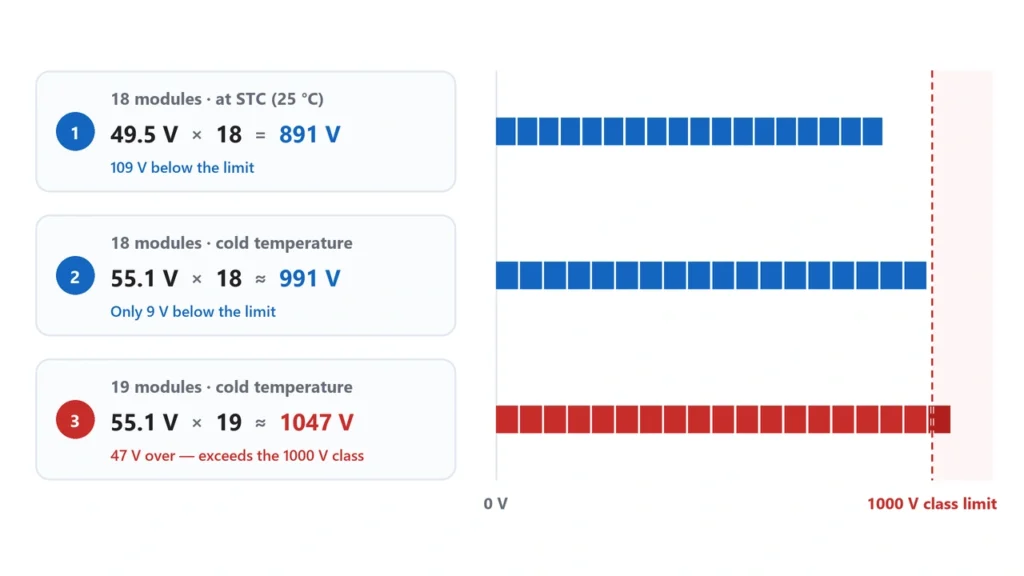
49.5 V × 18 = 891 V
At first glance, a 1000 V system appears sufficient.
But 891 V is not necessarily the maximum voltage the string can produce.
Cold Weather Increases PV Module Voc
PV module open-circuit voltage normally rises when cell temperature decreases.
This means the highest PV string voltage can occur during cold, bright conditions—not at STC.
The designer must therefore calculate cold-temperature Voc using the module manufacturer’s voltage-temperature coefficient and the minimum design temperature applicable to the project.
A simplified example:
Module Voc:
49.5 V
Voc temperature coefficient:
-0.25% / °C
Reference temperature:
25°C
Minimum module temperature used in this example:
-20°C
Temperature difference:
45°C
Approximate voltage increase:
45 × 0.25% = 11.25%
Cold module Voc:
49.5 × 1.1125 ≈ 55.1 V
For 18 modules:
55.1 × 18 ≈ 991 V
The same string that measured only 891 V at STC now approaches 1000 V.
Add another module:
55.1 × 19 ≈ 1047 V
A 1000 V fuse would no longer provide sufficient voltage rating for this calculated maximum.
This is why:
STC string Voc alone is not sufficient for selecting a PV fuse voltage.
IEC 62548-1:2023+A1:2025 covers current PV array design requirements, including DC array wiring and electrical protection devices.
The exact voltage calculation must follow the module documentation and the electrical standard or code governing the project.
1000V solar fuse voltage calculation using cold-weather PV VocIs a 1500V Solar Fuse Better Than a 1000V Fuse?
No.
A 1500 V fuse has a higher voltage capability, but that does not make it universally better.
The correct question is:
Which fuse matches the electrical system?
When 1000V Is Appropriate
A 1000 V fuse can be appropriate where the maximum calculated circuit voltage remains within its specified DC rating and all other protection requirements are satisfied.
Advantages can include:
- smaller fuse formats in some product families;
- smaller fuse holders;
- lower enclosure-space requirements;
- broad availability for conventional 1000 V PV architectures.
These are product-family characteristics rather than universal advantages of every 1000 V fuse.
When 1500V Is Required
A 1500 V fuse becomes relevant when the PV system can operate above the permissible voltage of a 1000 V device.
1500 V PV architecture allows more modules to be connected in series before reaching the system voltage limit.
At plant level, this can potentially reduce the number of parallel strings and related balance-of-system equipment for a given project architecture.
However:
1500 V system ≠ automatically lower string current
The electrical current produced by an individual module string is still determined primarily by module characteristics.
The principal change is that more module voltage can be placed in series.
Can You Use a 1500V Fuse in a 1000V System?
Potentially, but not simply because:
1500 V > 1000 V
A fuse with a voltage rating above the actual system voltage can be electrically acceptable in principle, but only when the entire specification remains suitable.
You must still check:
Current Rating
A 15 A 1500 V fuse and a 15 A 1000 V fuse can have different time-current characteristics.
Matching the printed ampere value is not enough.
Physical Size
Different voltage classes may use different fuse dimensions.
For example, Eaton’s current PV portfolio includes:
1000 V DC gPV → 10 × 38 mm
and examples of:
1500 V DC gPV → 10 × 85 mm
This is an industry example rather than a universal dimensional standard.
Fuse Holder
A 10 × 85 mm fuse obviously cannot replace a 10 × 38 mm fuse in the original holder.
Even where dimensions appear compatible, holder voltage, current and thermal ratings must still be checked.
Power Loss
Different fuse designs can have different watt losses.
This influences enclosure temperature and the thermal performance of the holder.
Time-Current Characteristic
Protection coordination must remain suitable for:
- PV module;
- conductor;
- downstream equipment.
Breaking Capacity
The selected fuse must still have adequate interrupting capability.
Certification
If the project requires IEC, UL or another certification, the actual replacement fuse and holder must satisfy that requirement.
Therefore:
A 1500 V fuse may sometimes be usable on a lower-voltage circuit, but it should not be treated as an automatic replacement for a 1000 V fuse.
For photovoltaic protection, compare the complete specifications in the DC Fuse range.
Does a 1500V Fuse Need a Different Fuse Holder?
Very often, yes.
The holder must be selected as part of the protection system.
A correctly rated fuse inside an unsuitable holder does not create a correctly rated assembly.
Important holder parameters include:
| Parameter | Requirement |
|---|---|
| DC voltage | At least the required system voltage |
| Rated current | Suitable for continuous circuit current |
| Fuse dimensions | Exact mechanical compatibility |
| Power dissipation | Compatible with the installed fuse |
| Terminal range | Suitable for conductor size |
| Temperature | Suitable for expected enclosure temperature |
| Mounting | Correct DIN rail or panel arrangement |
| Standard | Appropriate for project requirements |
Higher voltage can require greater creepage and clearance distances as well as longer internal arc paths.
This helps explain why 1500 V holders can be physically larger than 1000 V platforms.
As one current market example, Eaton lists:
1000 V DC PV fuse → 10 × 38 mm
while its 1500 V DC cylindrical platform includes:
10 × 85 mm fuse-links and matching 1500 V holders
in its photovoltaic application guide.
These Eaton dimensions illustrate the engineering difference but should not be copied as specifications for UHCCY products unless our own product data confirms them.
Current Rating Is Separate From Voltage Rating
Another common mistake is assuming that switching from 1000 V to 1500 V automatically changes the required fuse current.
It does not.
Consider:
1000 V / 20 A gPV
and:
1500 V / 20 A gPV
Both are 20 A fuse ratings.
Their voltage interruption capability differs, but the ampere rating remains 20 A.
Actual fuse current selection depends on parameters such as:
- module Isc;
- maximum circuit current;
- module maximum series fuse rating;
- conductor ampacity;
- number of parallel strings;
- temperature derating;
- applicable electrical rules.
That calculation is handled in detail in our Solar Fuse Sizing Guide.
The two decisions should therefore be separated:
Current calculation → required fuse amperage
and:
Maximum string voltage calculation → required fuse voltage
Only after both calculations are completed can the complete fuse specification be determined.
For example:
20 A / 1000 V DC / gPV
or:
20 A / 1500 V DC / gPV
How to Select Between 1000V and 1500V PV Fuses
A practical selection sequence is:
1. Obtain the actual PV module datasheet
Confirm:
Voc
Isc
Voc temperature coefficient
maximum system voltage
maximum series fuse rating
2. Determine modules per string
This establishes the base string voltage.
3. Calculate maximum cold-temperature Voc
Do not use STC Voc alone.
4. Select the voltage class
Choose a PV fuse with rated DC voltage at least equal to the calculated maximum circuit voltage.
5. Calculate the fuse current
Use the applicable PV protection method rather than deriving current from system voltage.
6. Verify gPV suitability
See our gPV Fuse Guide for the photovoltaic utilization category.
7. Check breaking capacity
Confirm adequate fault-current interruption capability.
8. Match the fuse holder
Check both electrical and mechanical compatibility.
9. Verify conductor coordination
The fuse must protect the installed cable and remain within equipment protection limits.
10. Verify certifications
Check the exact certificates required for the target market or project.
The final selection should therefore resemble:
Voltage Class + Current Rating + gPV + Breaking Capacity + Fuse Format + Holder
rather than simply:
1000 V or 1500 V
Choosing 1000V or 1500V Fuses for a Solar Project
For a B2B RFQ, EPC project or PV combiner-box design, provide the electrical data that determines the voltage class.
Useful information includes:
PV module model
→ Module Voc
→ Voc temperature coefficient
→ Minimum design temperature
→ Modules per string
→ Maximum calculated string voltage
→ Module Isc
→ Maximum series fuse rating
→ Required fuse current
→ Applicable IEC / UL requirement
This allows the fuse and holder to be selected as a coordinated system.
The most important principle is:
Do not select a 1000 V fuse because the array is called a “1000 V system,” and do not select a 1500 V fuse simply because the higher number appears safer.
Calculate the actual maximum DC voltage first.
Then verify current rating, gPV category, breaking capacity, fuse dimensions, holder compatibility and the required certification.
For UHCCY photovoltaic fuse-link and holder options, see the DC Fuse range.
If you still need to determine whether the individual PV strings require overcurrent protection at all, start with the Solar Panel Fuse Guide.