Table of Contents
An MC3 connector is a legacy photovoltaic DC connector still found on older solar modules and installations.
It preceded the later MC4 connector system and differs in several important ways, particularly in contact size, housing design and locking method.
For a new PV project, the practical question is rarely:
“Should I choose MC3 or MC4?”
MC3 is now mainly a legacy-system maintenance issue.
The more useful questions are:
How do I identify an MC3 connector? Can MC3 and MC4 connect directly? Should an old MC3 system be converted? And if it is converted, how should the transition be made without introducing another unreliable connection?
MC4 is a protected trademark. UHCCY uses Solar Connector and PV Connector for its own products.
For current PV connection products, see Solar Connector.
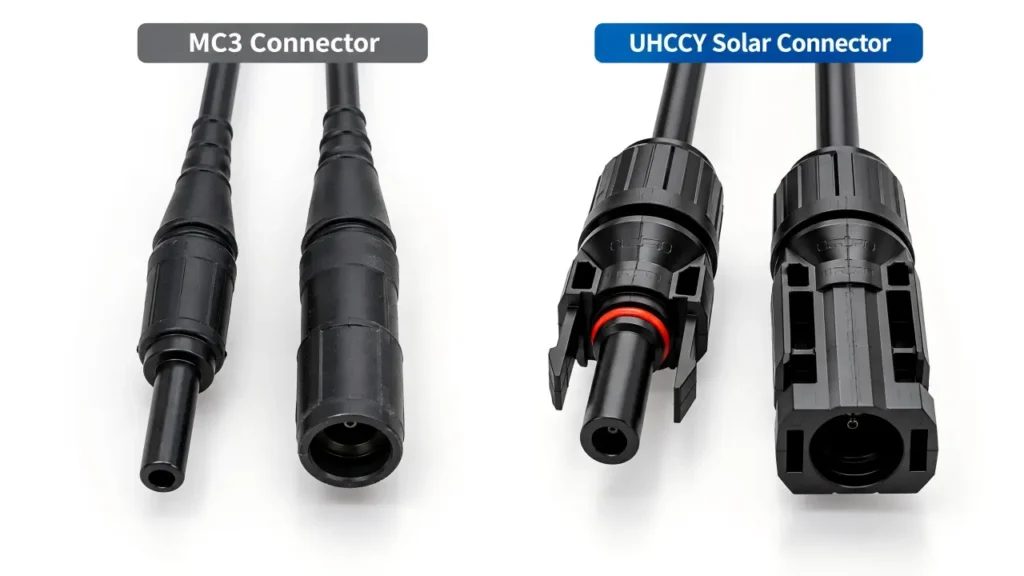
What Is an MC3 Connector?
MC3 belongs to an earlier generation of single-pole photovoltaic connectors.
The original MC3 and MC4 product families were developed sequentially, with MC3 appearing before the later locking MC4 design. The current market has largely moved toward locking 4 mm PV connector systems, while MC3 is mainly encountered when servicing older equipment.
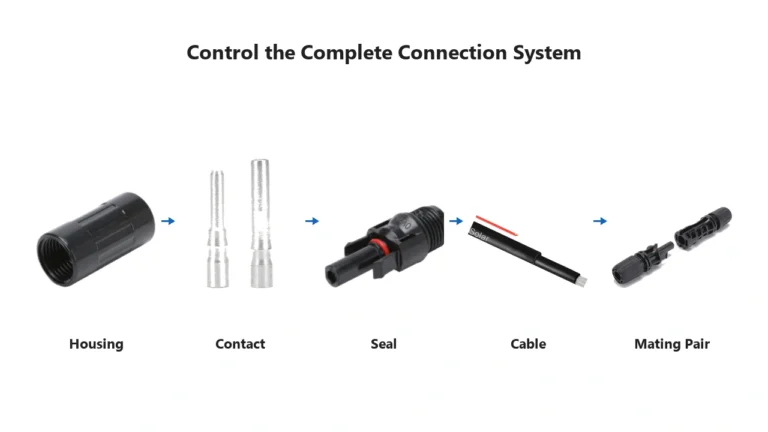
An MC3 connector normally consists of:
- single DC conductor
- crimped metal contact
- insulated housing
- cable seal
- complementary plug/socket connection
The basic purpose is therefore similar to a modern PV connector:
create a weather-resistant removable DC connection between photovoltaic conductors.
The important differences are in how that connection is physically made and retained.
MC3 vs MC4 at a Glance
| Feature | MC3 | MC4 |
|---|---|---|
| Generation | Legacy | Later/current generation |
| Contact family | 3 mm class | 4 mm class |
| Locking concept | Push/friction connection | Positive locking system |
| Tool release | Not the defining design feature | Lock generally requires intentional release |
| Direct mating | MC3 only | Defined MC4 mating system |
| New installations | Mainly legacy/service | Widely used |
| Main issue today | Maintenance and conversion | Selection, compatibility and installation |
One important warning:
This table compares connector architecture, not universal electrical ratings.
Do not assume that every MC3 connector has one voltage/current/IP rating and every MC4 connector has another.
Ratings belong to the exact product, cable and documented configuration.
What Do the “3” and “4” Mean?
The number is commonly associated with the approximate contact-pin diameter:
MC3 → 3 mm contact class
MC4 → 4 mm contact class
It does not mean:
- 3 mm² vs 4 mm² cable
- 3 A vs 4 A current
- third generation vs fourth generation
This distinction matters because cable size is a separate specification.
A 4 mm PV connector, for example, may support several conductor cross-sections depending on its contact design.
A 2025 Solar Energy technical paper addressing confusing PV connector terminology specifically proposed using the generic term “4 mm single-pole DC PV connector” for this wider class, because “MC4 compatible” can incorrectly imply documented intermatability between different products.
That paper also distinguishes these products from older 3 mm systems such as MC3.
Technical reference: Photovoltaic connector terminology and cross-mating research.
This is also why UHCCY should continue using Solar Connector / PV Connector for its own products rather than treating MC4 as the generic product name.
The Biggest Practical Difference: Locking
One of the most important changes between MC3 and the later MC4 architecture is the connector retention system.
MC3 relies on an older push-fit connection concept.
MC4 introduced a positive locking arrangement designed to reduce accidental separation.
That difference matters in photovoltaic systems because DC connectors should not simply pull apart due to:
- cable movement
- maintenance handling
- vibration
- mechanical disturbance
A locking connector also makes disconnection a deliberate maintenance action rather than an accidental pull-apart event.
That does not mean the lock makes a connector safe to disconnect under load.
Normal PV connectors are not load-break switches.
For the disconnection process, see How to Disconnect MC4 Connectors.
MC3 and MC4 Are Not Directly Compatible
An MC3 connector should not be plugged directly into an MC4 connector.
They belong to different mechanical/contact systems.
The differences include:
- contact dimensions
- housing geometry
- retention method
- sealing arrangement
- mating interface
Therefore:
MC3 male + MC4 female ≠ valid mating pair
and:
MC4 male + MC3 female ≠ valid mating pair.
Unlike the confusing situation where two different 4 mm PV connector brands may physically cross-mate, MC3 and MC4 are visibly different generations.
To transition between them, a purpose-designed cable assembly or an approved replacement strategy is required.
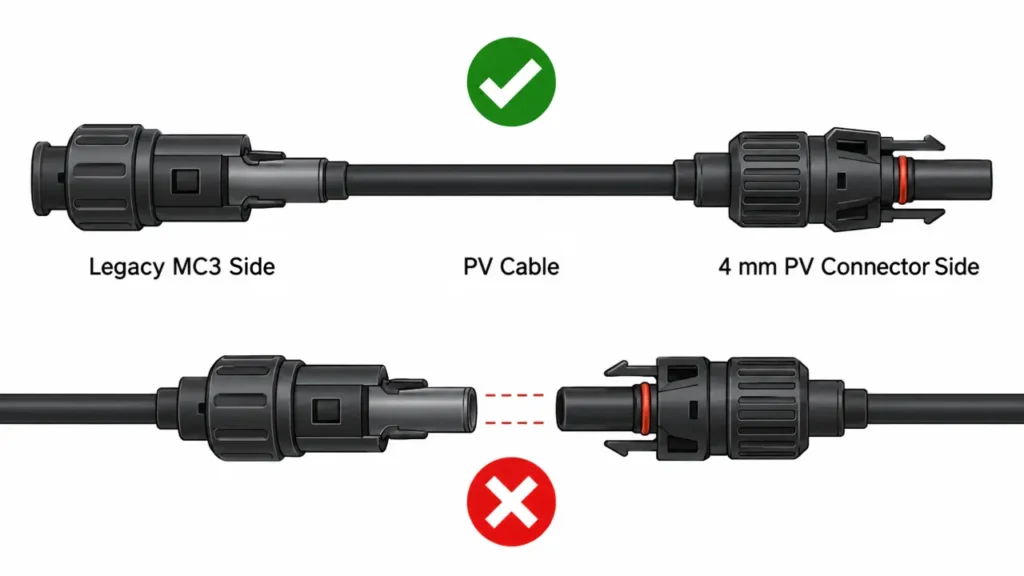
How an MC3-to-MC4 Adapter Cable Works
An MC3-to-MC4 adapter should be understood as a cable assembly, not as a magic connector that makes the two systems directly compatible.
Conceptually:
Existing MC3 → MC3 mating connector → PV cable → modern connector → matching modern connector
The MC3 interface remains an MC3 mating pair.
The modern interface remains its own matching connector pair.
The cable between them performs the transition.
This is fundamentally different from trying to force:
MC3 housing → MC4 housing
together.
Is an MC3-to-MC4 Adapter Safe?
The answer depends on the complete adapter and equipment requirements, not the words “MC3 to MC4” alone.
Check:
- exact MC3 mating connector
- exact modern mating connector
- cable type
- conductor size
- voltage rating
- current requirement
- polarity
- assembly quality
- applicable equipment manufacturer’s instructions
Current equipment guidance demonstrates why this needs to be checked case by case.
For example, Tigo’s September 2026 guidance permits adapter cables or “whips” with its equipment under defined conditions, while noting that other equipment vendors may not permit them. It also recommends that each actual mating interface use connectors of the same type and manufacturer.
The useful rule is:
An adapter cable can transition between systems without cross-mating the connector interfaces, but the equipment and adapter still need to be approved for the application.
Should You Replace Old MC3 Connectors With Modern Connectors?
Not automatically.
Finding MC3 connectors in an existing installation does not mean that every connector should immediately be cut off.
First evaluate:
condition → documentation → equipment requirements → reason for the modification
A serviceable legacy installation may be handled differently from a system with:
- damaged MC3 connectors
- corroded contacts
- repeated connection failures
- replacement modules with another connector system
- inverter or optimizer replacement
- extension work
- unavailable legacy replacement parts
The best solution can therefore vary between:
retain
adapt
or:
replace
depending on the system.
Adapter Cable vs Re-Terminating the Module Lead
There are two fundamentally different retrofit approaches.
Adapter Cable
Keeps the original factory lead intact and creates a transition using a separate cable assembly.
Potential advantages:
- original module connector remains unchanged
- transition can be inspected as a separate assembly
- easier to reverse
- avoids immediately modifying the module lead
Potential concerns:
- adds another connector pair
- adapter rating must be verified
- equipment manufacturer may restrict its use
- poor-quality adapters can introduce another failure point
Re-Terminating the Existing Cable
Removes the old connector and installs another connector onto the remaining cable.
Potential advantages:
- eliminates the intermediate adapter connection
- creates one connector system downstream
But it also raises more serious questions:
- Is modification of the module lead permitted?
- Is enough cable length available?
- Does the new connector support the original cable?
- Is the cable OD within the sealing range?
- Is the correct contact and crimp tooling available?
- Does the change affect product certification, listing or warranty?
Therefore:
Cutting off an MC3 connector should not be the automatic first recommendation.
Follow the equipment manufacturer’s permitted repair or modification procedure.
Do Not Convert Only One Half of a Mating Pair
A retrofit should not create an undocumented mixed mating interface.
If a connector system is being changed, the objective should be to create:
defined connector A ↔ defined connector A
on one side of the transition, and:
defined connector B ↔ defined connector B
on the other.
Do not select a replacement housing simply because it appears to lock into the connector already installed.
The same compatibility principles apply as they do to any current PV connection.
See MC4 Connector Compatibility.
Electrical Ratings Still Need to Be Rechecked
One common oversimplification is:
“MC4 is newer, so it automatically has a higher rating.”
That is not a safe engineering assumption.
Legacy MC3 products existed in different documented configurations, while current 4 mm PV connector families also vary significantly.
When converting an old system, confirm:
- system voltage
- string current
- cable cross-section
- cable OD
- temperature/environmental conditions
- connector rating
- adapter rating where used
The transition is limited by the applicable rating of the complete connection path.
For rating principles, see MC4 Connector Specifications.
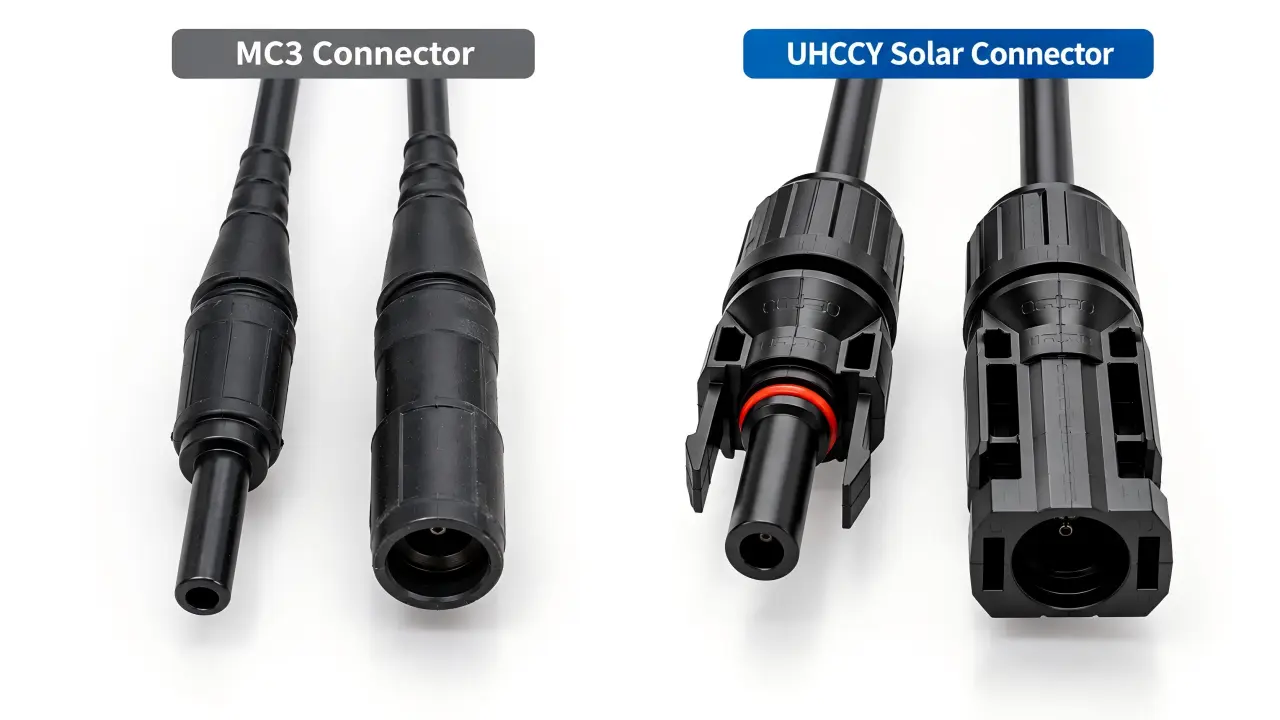
How to Identify MC3 and MC4 in an Existing PV System
Start with the connector itself rather than assuming its type from the age of the solar panel.
Look at the Locking System
A modern locking connector usually has clearly visible latch/locking features.
MC3 has a simpler legacy push-fit form.
Look at the Housing Shape
MC3 housings are generally slimmer and visually different from the later locking 4 mm connector architecture.
Check Markings
Look for:
- manufacturer
- model
- voltage
- current
- certification marks
- molded identifiers
Do not identify a connector only by:
“black round solar connector.”
Check Both Ends
A repaired installation may contain more than one connector system.
Do not assume every module in an old array still has its original connectors.
Document Before Changing Anything
Photograph both connector halves and record their markings before disconnecting or cutting cables.
This information is difficult to recover afterward.
MC3 Maintenance Is Also a Documentation Problem
Older PV systems can be difficult to service for a reason that has little to do with the physical connector:
documentation has disappeared.
After 10–20 years, maintenance teams may not know:
- original connector manufacturer
- exact model
- cable specification
- previous repair history
- whether a connector was replaced
- whether an adapter was added later
This means an old system can contain several generations of connection hardware even if all the modules originally shipped with the same connector.
For maintenance, the connector should therefore be treated as an identifiable component rather than a generic “solar plug.”
A useful service record includes:
Array/Module → Connector Manufacturer → Connector Model → Cable → Replacement History
This makes future repairs safer and faster.
The Bigger Lesson From MC3: Avoid Generic Connector Names
MC3 is easy to distinguish from current 4 mm connectors because the interface changed significantly.
The harder modern problem is that many different 4 mm PV connectors now look superficially similar.
This has led to terms such as:
MC4 type
MC4 style
MC4 compatible
being used broadly across the market.
The 2025 PV connector terminology research argues that this language can encourage incorrect assumptions about intermatability and recommends clearer generic terminology for 4 mm single-pole DC PV connectors.
That historical progression gives us a useful purchasing lesson:
Identify connectors by manufacturer and model—not by appearance or a generic family nickname.
For UHCCY products, this is why our product pages use Solar Connector as the generic product class and maintain individual product model numbers.
Legacy-System Procurement Checklist
If you are purchasing parts for a system containing MC3 connectors, collect the following information before requesting a quotation:
| Item | What to record |
|---|---|
| Existing connector | Manufacturer and model |
| Photos | Both mating halves |
| Module/equipment | Manufacturer and model |
| System voltage | Actual design requirement |
| Circuit current | Actual string requirement |
| Existing cable | Conductor size |
| Cable OD | Required for sealing |
| Condition | Normal / damaged / corroded |
| Required work | Repair / extension / equipment replacement |
| Preferred solution | Adapter / replacement / engineering review |
| Quantity | Number of transitions required |
Do not send only:
“Need MC3 to MC4 connector.”
That does not define which actual mating components are present.
Key Takeaway
MC3 vs MC4 is no longer primarily a new-product selection question.
It is a legacy maintenance and transition problem.
The most useful rules are:
- MC3 is an older 3 mm-class PV connector system; modern locking PV connectors commonly use a 4 mm-class contact architecture.
- The 3 and 4 describe the connector/contact family, not cable cross-section.
- MC3 and MC4 are different mating systems and should not be directly connected.
- A proper adapter cable keeps each connector interface within its own mating system.
- Do not assume an adapter is permitted for every module, inverter or optimizer.
- Do not automatically cut factory MC3 connectors off an old module without checking the permitted repair method.
- A retrofit must still verify cable, current, voltage and sealing requirements.
- Replacing only one side with a visually similar connector can create a new compatibility problem.
- Document the original connectors before modifying a legacy PV array.
- Modern maintenance should identify PV connectors by exact manufacturer and model rather than generic appearance.
The useful question is no longer:
“Is MC4 better than MC3?”
It is:
“What is the safest documented way to maintain or transition this particular legacy MC3 connection?”