Table of Contents
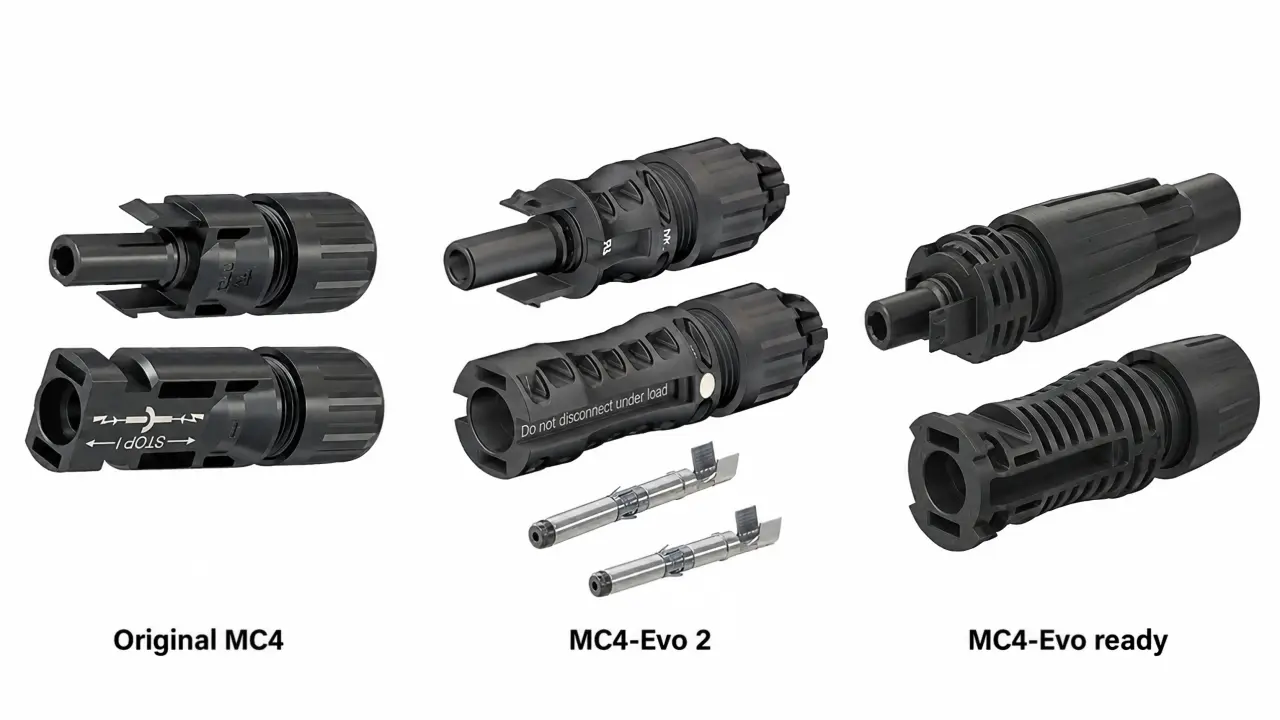
If you are comparing MC4 Evo2 with Original MC4 or MC4-Evo ready, the names can make the three products sound like simple generations of the same connector.
That is only partly true.
They belong to the same branded connector family, but they solve different installation requirements.
The most important differences are not just appearance. They include:
termination method → voltage platform → current capability → cable range → tooling → intended application.
MC4 and MC4-Evo are protected trademarks of Stäubli. This article explains those branded systems because installers and buyers frequently encounter them when identifying existing PV equipment.
UHCCY products are described separately as Solar Connector or PV Connector and should not be represented as Original MC4 products.
For UHCCY connector platforms, see Solar Connector.
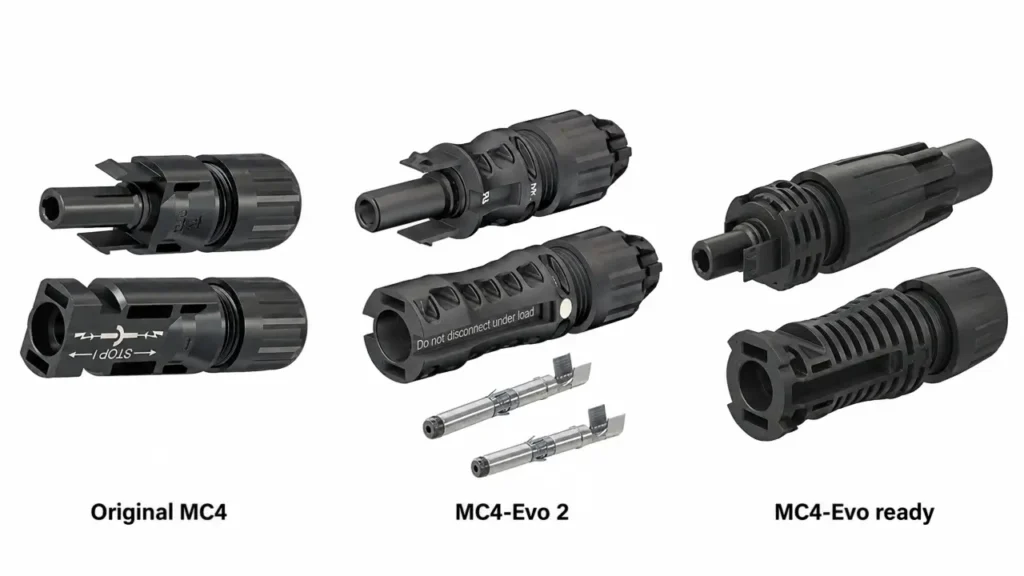
What Are Original MC4, MC4-Evo 2 and MC4-Evo ready?
All three belong to the Original MC4 product portfolio, but they are not three interchangeable names for exactly the same product.
In simplified terms:
Original MC4 is the established crimp-terminated connector platform.
MC4-Evo 2 is the higher-performance crimp-terminated platform designed around modern 1500 V PV applications and higher-current configurations.
MC4-Evo ready takes a different approach: it uses a spring-clamp termination, allowing the conductor to be installed without a conventional crimping operation.
That last distinction is particularly important.
MC4-Evo ready is not simply:
“MC4-Evo 2 without a crimp tool.”
Its termination system and current range are different.
Quick Comparison
The following comparison refers to current documented product configurations and should not be interpreted as a universal specification for every historical variant.
| Feature | Original MC4 | MC4-Evo 2 | MC4-Evo ready |
|---|---|---|---|
| Connector family | Original MC4 | Original MC4 | Original MC4 |
| Main termination | Crimp | Crimp | Spring clamp |
| Conventional crimp tool required | Yes | Yes | No |
| 1500 V platform | Configuration/certification dependent | Yes | Yes, IEC |
| Current capability | Model/cable dependent | Up to 69 A in current documented configurations | 30 A |
| Typical conductor range | Product dependent | 2.5–10 mm² depending on configuration | 4 / 6 mm² |
| Installation emphasis | Established general-purpose system | Higher-current / 1500 V applications | Simplified field termination |
| Mating relationship | Defined within Original MC4 family | Defined within Original MC4 family | Defined within Original MC4 family |
The critical point is:
Do not choose between them only by housing appearance.
Original MC4: The Established Crimp-Terminated Platform
Original MC4 remains part of the current product portfolio.
It should not be confused with MC3, which is genuinely a legacy connector generation.
Original MC4 uses a conventional contact termination process in which the conductor is:
stripped → inserted into the metal contact → crimped → contact inserted into the housing.
This is the installation model that most PV installers associate with field-assembled 4 mm solar connectors.
Its exact voltage and current ratings depend on the specific product configuration and certification basis.
That qualification matters because current official documents do not reduce the entire Original MC4 family to one universal voltage/current pair.
When comparing with another connector, use the exact product designation rather than simply the name “MC4.”
MC4-Evo 2: The Higher-Performance Crimp Platform
MC4-Evo 2 retains crimp termination but expands the performance envelope for modern PV applications.
Current official technical documentation lists MC4-Evo 2 at:
- DC 1500 V
- up to 69 A depending on conductor and certification configuration
- conductor sizes including 2.5, 4, 6 and 10 mm² in applicable versions
- locking 4 mm connector architecture
The current 69 A figure is associated with the applicable 10 mm² IEC configuration, not every MC4-Evo 2 connector.
For example, current IEC ratings listed for specific configurations increase according to conductor size rather than using one current rating for every cable. Staubli
This is another example of why connector current should not be separated from conductor configuration.
For the general relationship between conductor size and connector rating, see MC4 Connector Specifications.
MC4-Evo ready: The Main Difference Is Termination
MC4-Evo ready is easiest to understand by starting with its termination method.
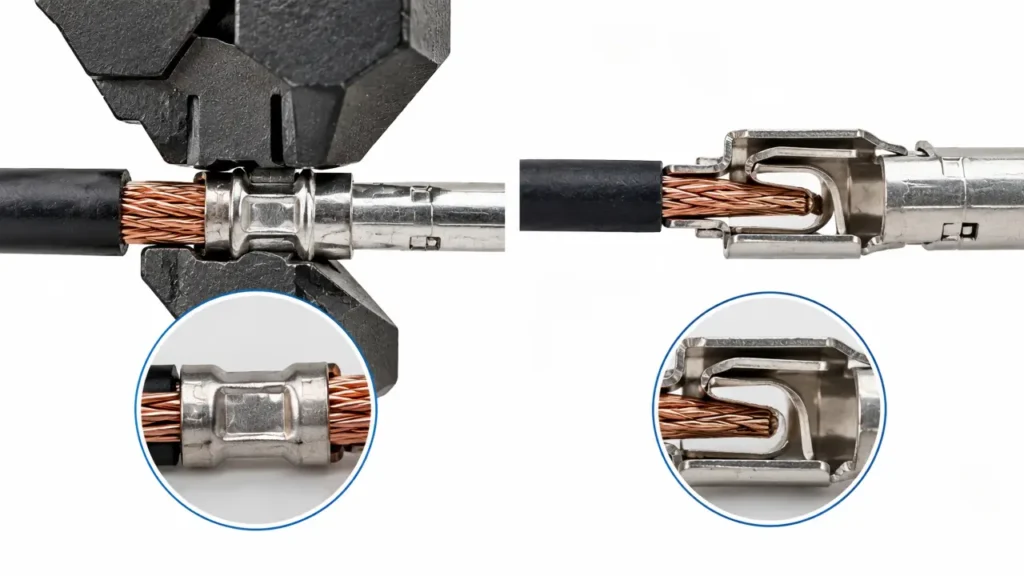
Instead of crimping the conductor into a separate crimp contact using a conventional PV crimper, the connector uses an automatically closing spring-clamp connection.
The current official specification lists:
Rated voltage: 1500 V DC
Rated current: 30 A
Cable cross-section: 4 mm² / 6 mm²
Cable OD: 5.4–7.6 mm
Termination: spring clamp
The stripped conductor is inserted according to the assembly procedure and the connector is completed without the normal contact-crimping operation. Staubli
This makes MC4-Evo ready primarily interesting as an installation-method alternative, not simply as a higher-spec MC4-Evo 2.
Crimp vs Spring Clamp Is the Biggest Practical Difference
For installers, this is arguably the most important comparison.
Original MC4 / MC4-Evo 2
The termination process depends on the correct combination of:
cable → contact → die → crimping tool.
Crimp quality therefore depends on:
- contact selection
- conductor size
- stripping
- crimp tool
- die geometry
- tool condition
- operator process
For more detail, see MC4 Crimping Tool Guide and How to Crimp MC4 Connectors.
MC4-Evo ready
The spring-clamp system removes the conventional crimping operation.
That reduces dependence on:
- separate loose crimp contacts
- compatible crimp dies
- calibrated or controlled crimp tooling
But it does not remove the need for correct installation.
The installer still has to follow requirements for:
- conductor size
- cable OD
- strip preparation
- conductor insertion
- housing assembly
- torque/assembly procedure where specified
- mating system
So:
Crimp-free does not mean installation-free.
Voltage Differences Are More Complicated Than “1000V vs 1500V”
A common comparison says:
MC4 = 1000 V
MC4-Evo 2 = 1500 V
That is too simplistic.
Under the current certified mating documentation, specific Original MC4 configurations are listed at 1000 V under IEC, while applicable UL configurations are listed at 1500 V.
MC4-Evo 2 is documented as a 1500 V platform under both applicable IEC and UL configurations.
MC4-Evo ready is currently specified as a 1500 V IEC connector. Staubli
So the correct conclusion is not:
“Original MC4 can never be used at 1500 V.”
The correct conclusion is:
Check the exact product designation, certification basis and system requirement.
For a broader explanation, see 1000V vs 1500V Solar Connectors.
Current Rating Is Not a Generation Number
Another oversimplification is:
newer connector = more amps.
MC4-Evo 2 does offer higher-current configurations than many traditional MC4 configurations, but its current rating still depends on conductor and certification basis.
MC4-Evo ready illustrates the opposite case clearly.
Although it belongs to the newer product portfolio and supports 1500 V DC, its current rating is 30 A.
So:
newer ≠ automatically higher current
and:
higher voltage ≠ automatically higher current.
Voltage, current and termination method should be compared separately.
Cable Size Still Matters
Connector selection must consider both:
conductor cross-section
and:
cable outside diameter.
For MC4-Evo ready, the current documented cable range is especially clear:
4 / 6 mm² conductor
with:
5.4–7.6 mm cable OD.
A cable being 4 mm² does not prove its jacket diameter fits the sealing system.
The same basic rule applies to crimped connectors.
Always check:
conductor → contact/termination → cable OD → seal.
Do not select a connector only because the conductor size appears in a catalog title.
Are Original MC4, MC4-Evo 2 and MC4-Evo ready Mateable?
Within the defined Stäubli product family, current certification documentation provides approved mating correlations between specified:
- Original MC4 cable couplers
- MC4-Evo 2 / Evo 2A cable couplers
- MC4-Evo ready cable couplers
- applicable panel receptacles
- applicable branch connectors
The official mating-correlation statement is available here:
Stäubli MC4 Product Family Intermateability Statement
This is an important example of what documented intermatability actually looks like.
It identifies specific product families and certified combinations.
However, it should not be generalized to:
“Any connector called MC4-style can mate with these products.”
The documented relationship applies to the products covered by that manufacturer’s certification.
For the broader issue, see MC4 Connector Compatibility.
Does MC4-Evo 2 Replace Original MC4?
Not in the sense that every Original MC4 installation should be converted.
Existing documented MC4 systems do not need to be replaced simply because MC4-Evo 2 exists.
MC4-Evo 2 becomes more relevant where a project needs features such as:
- 1500 V IEC architecture
- higher-current conductor configurations
- harsher environmental qualification
- modern high-power module/string design
For maintenance of an existing system, the first question should remain:
What exact connector system is already installed?
Do not replace one half of a mating pair only because another connector has a higher headline rating.
When Does MC4-Evo ready Make Sense?
MC4-Evo ready is particularly relevant when the installation benefits from eliminating conventional field crimping.
Potential situations include:
- service work where compatible crimp tooling is not available
- controlled field assembly where fewer loose parts are preferred
- applications within the documented 30 A current limit
- 4 mm² or 6 mm² PV cable within the specified OD range
- projects that specifically require the documented Original MC4 family mating relationship
Its main advantage is therefore process simplification.
But it is not automatically the better option for:
- currents above its specified rating
- unsupported cable sizes
- systems using unrelated connector families
- applications requiring another certification route
The right choice follows the electrical and installation requirements.
Tooling Requirements Are Different
Original MC4 and MC4-Evo 2 are crimp systems, so installation requires suitable crimp tooling for the intended contacts.
Do not assume that one generic “MC4 crimper” is approved for every Original MC4 family contact.
Different contacts and connector variants can require different tooling.
MC4-Evo ready removes the crimp tool from the conductor termination step because it uses a spring-clamp connection.
This can reduce one source of installation variability, but it does not eliminate:
- stripping requirements
- assembly instructions
- cable compatibility
- connector locking requirements
- inspection
This is why procurement should ask:
What termination process does the project want to control?
not simply:
Which connector looks easiest to assemble?
Common Naming Mistakes
Calling Every 4 mm PV Connector “MC4”
MC4 is a trademarked product family, not the technical generic name for every visually similar photovoltaic connector.
UHCCY should continue using:
Solar Connector
or:
PV Connector
for its own products.
Calling MC4-Evo ready “MC4-Evo 2 Ready”
They are separate product names.
Use:
MC4-Evo 2
and:
MC4-Evo ready.
Assuming “Evo” Means Universal Compatibility
It does not.
Compatibility comes from the documented mating relationship, not the word Evo.
Assuming Crimp-Free Means Tool-Free Installation in Every Sense
The conductor termination does not require conventional crimping, but installation still requires cable preparation and correct assembly.
Assuming 1500 V Means High Current
MC4-Evo ready is a useful counterexample: 1500 V and 30 A.
What This Means When Buying Non-Stäubli Solar Connectors
This comparison also teaches a broader procurement lesson.
Do not transfer Stäubli product specifications to another manufacturer’s connector simply because the other product:
- looks similar
- uses a 4 mm contact
- has a similar latch
- is advertised using “MC4 type”
- claims physical mating compatibility
For a UHCCY connector, use UHCCY’s own model-specific data.
For example, a UHCCY 1500 V connector should be selected from its own:
- rated voltage
- current
- conductor range
- cable OD
- termination
- certification status
not from MC4-Evo 2 specifications.
The UHCCY connector family can be reviewed at Solar Connector.
How to Choose Between the Three
For an actual Original MC4-family project, the decision process can be simplified to:
Existing mating system → System voltage → Required current → Cable size/OD → Crimp or spring-clamp termination → Required certification → Exact product model
In general:
Original MC4
makes sense where the established MC4 platform and its documented configuration meet the system requirement.
MC4-Evo 2
becomes more relevant where 1500 V IEC operation, higher-current configurations or the Evo 2 environmental/performance platform is required.
MC4-Evo ready
becomes relevant where 1500 V / 30 A is sufficient and eliminating conventional field crimping provides an installation advantage.
Do not reduce the choice to:
old → better → easiest.
They are different engineering options.
Key Takeaway
Original MC4, MC4-Evo 2 and MC4-Evo ready belong to the same branded connector family, but they should not be treated as three names for the same connector.
The most important distinctions are:
- Original MC4 and MC4-Evo 2 use conventional crimp termination.
- MC4-Evo ready uses a spring-clamp termination and does not require conventional contact crimping.
- MC4-Evo 2 is a defined 1500 V high-performance platform with current capability dependent on conductor/configuration.
- MC4-Evo ready is currently specified at 1500 V / 30 A for 4 and 6 mm² cable.
- Original MC4 ratings depend on the exact product and certification configuration.
- Higher voltage does not automatically mean higher current.
- Newer product naming does not automatically mean a connector is a replacement for every earlier installation.
- Certified mating compatibility applies to defined product combinations—not every 4 mm PV connector that looks similar.
- Cable cross-section and cable OD both need to match the connector.
- For non-Stäubli products, use that manufacturer’s own specifications rather than copying Original MC4 family ratings.
The useful comparison is therefore not:
“Which generation is best?”
It is:
“Which termination method, electrical rating and documented mating system fits this specific PV application?”