“1000V, 30A, IP67” tells you what an MC4 connector can handle. It doesn’t tell you how to actually wire your panels — and getting that decision wrong is one of the most common reasons DIY solar installs underperform or trip an inverter’s voltage protection.
This guide to MC4 connector wiring walks through both series and parallel methods step by step, so whether you’re wiring two panels for an RV, building a residential rooftop string, or speccing a commercial array, you’ll know exactly which method fits your system — and why. We cover the voltage and current math behind each method, and — since MC4 connectors are also something we manufacture every day — a few things generic wiring guides tend to leave out: why connector consistency matters, when mixing brands becomes a real safety issue, and how to translate your wiring plan into the right connector specification for procurement.
The full guide can be found at: MC4 Connector: The Complete Guide to Solar Panel Connectors
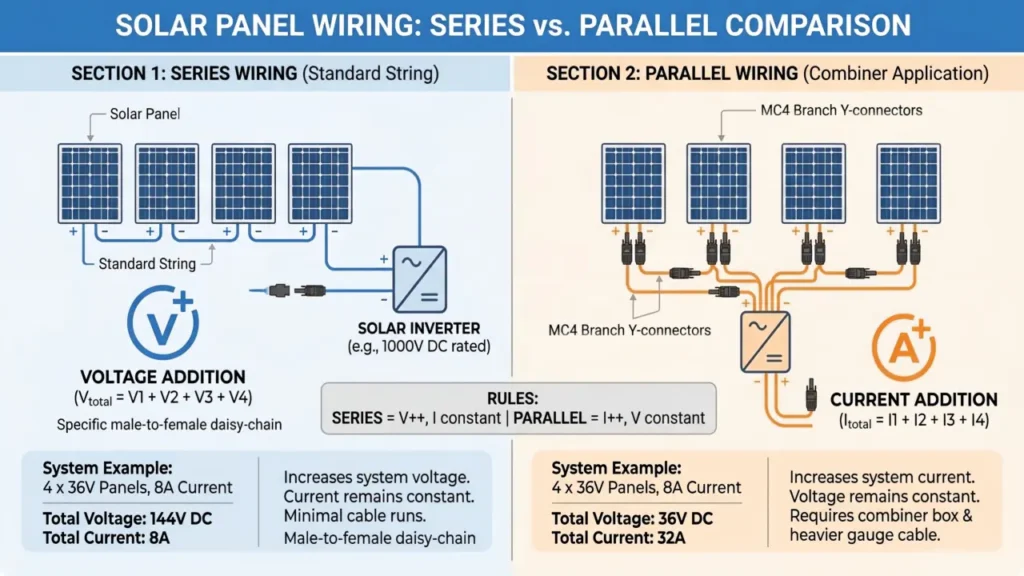
MC4 Connector Wiring Summary: Series vs Parallel at a Glance
- Series wiring adds voltage, keeps current the same — the default for residential string inverters.
- Parallel wiring adds current, keeps voltage the same — common in low-voltage battery and off-grid systems.
- Series-parallel combines both and is standard for commercial-scale arrays.
- Never mix MC4 connector brands or batches within the same string, and always fuse parallel strings per code.
The rest of this guide breaks each part of MC4 connector wiring down with step-by-step instructions, calculations, and sourcing guidance.
What Is Series and Parallel Wiring in Solar Systems?
Every MC4 connection you make falls into one of two electrical relationships. Understanding the difference before you pick up a crimping tool saves you from a miswired string later.
Series Wiring: How Voltage Adds Up
In a series connection, you join the positive MC4 lead of one panel to the negative MC4 lead of the next. Electrically, this stacks the voltages while the current stays the same as a single panel.
For example, three 400W panels rated at 40V Vmp and 10A Imp, wired in series, produce roughly 120V at 10A. This is the default configuration for most residential string inverters and MPPT charge controllers, because higher voltage means less current — and less current means you can use thinner, cheaper cable over long runs.
Parallel Wiring: How Current Adds Up
In a parallel connection, all the positive leads join together and all the negative leads join together, using MC4 Y-branch or T-branch connectors (or a combiner box for larger arrays). Voltage stays the same as a single panel, but current adds up.
Using the same three 400W panels wired in parallel instead: roughly 40V at 30A. Parallel wiring is common in low-voltage battery systems (12V/24V/48V off-grid setups) and situations where panels face different directions or receive different amounts of shade, since a shaded panel in a parallel array doesn’t drag down the whole string’s voltage the way it can in series.
Series-Parallel (Mixed) Configuration
Most mid-size and commercial systems combine both: panels are wired in series to form a string, and multiple strings are then wired in parallel to reach the target power output. This is how larger arrays balance the inverter’s voltage window against the current-carrying capacity of the wiring and combiner equipment.
How to Wire MC4 Connectors in Series [Step-by-Step]
Tools and Materials Needed
- MC4-rated solar cable (typically 4mm² or 6mm², matched to your current)
- Male and female MC4 connector pairs (if not pre-terminated on your panel leads) — see our MC4 Connector range for IP67-rated options
- An MC4 crimping tool — never substitute standard pliers
- Wire stripper and multimeter
Step-by-Step Series Connection Process
- Confirm polarity on both panels using a multimeter before connecting anything — reversed polarity can damage panels or downstream equipment.
- De-energize the array. Cover panels or work at dawn/dusk to minimize live voltage while connecting.
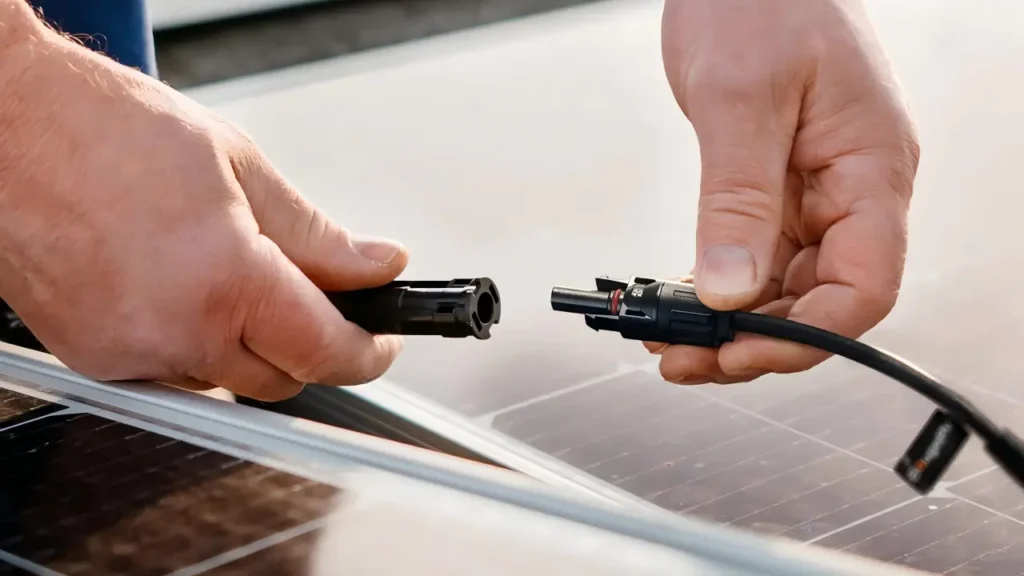
- Connect Panel 1’s positive MC4 lead to Panel 2’s negative MC4 lead. Push firmly until you hear the locking click.
- Repeat for each additional panel in the string, always positive-to-negative.
- Leave the free positive (first panel) and free negative (last panel) leads as your string output, ready to route to the combiner box, charge controller, or inverter.
- Verify output voltage with a multimeter before connecting to any downstream equipment.
Voltage Calculation Example
Open-circuit voltage (Voc) — not Vmp — is the number that matters for safety, because it’s the maximum voltage the string can produce in cold weather when no load is connected. A panel rated at 45V Voc at standard test conditions can rise significantly above that in freezing temperatures. Always check your inverter or charge controller’s maximum input voltage and apply a cold-temperature correction factor (available from the panel manufacturer’s datasheet) before finalizing string length — this is one of the most common causes of inverter damage in DIY installs.
How to Wire MC4 Connectors in Parallel [Step-by-Step]
Using Y-Branch / T-Branch Connectors
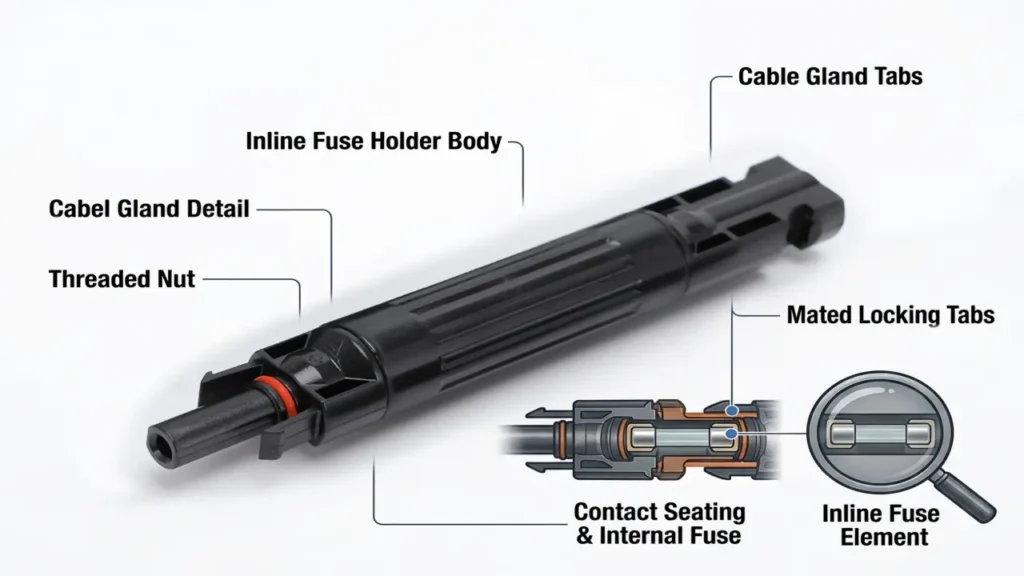
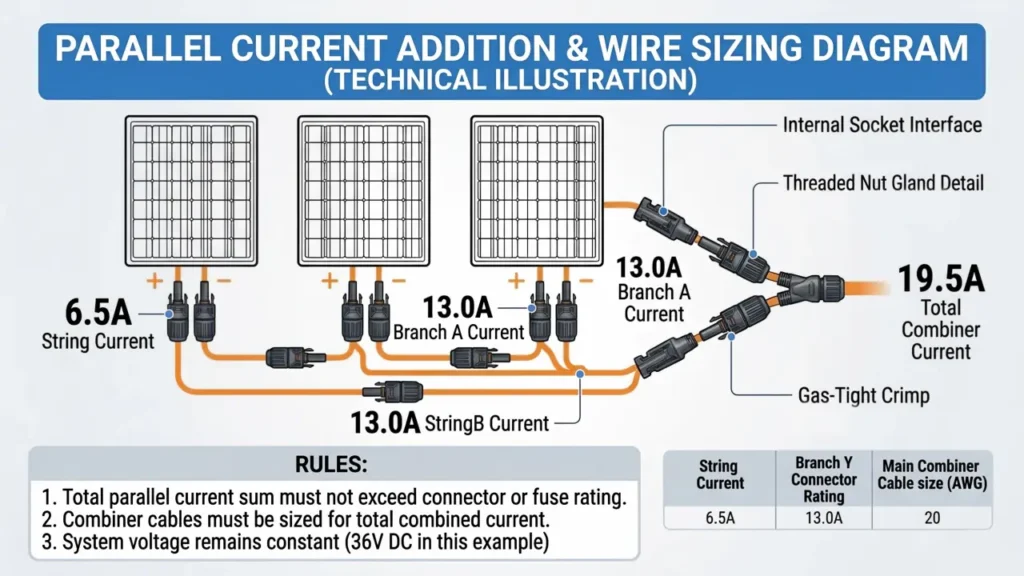
For two or three panels, an MC4 Y-branch connector is the simplest way to combine outputs without a combiner box. One branch connector accepts two male MC4 leads and outputs a single male connector; the matching branch connector does the same for female leads.
- Plug each panel’s positive lead into the male-input Y-branch connector.
- Plug each panel’s negative lead into the female-input Y-branch connector.
- Route the two combined output leads to your controller, inverter, or combiner box.
When You Need a Combiner Box
Once you’re paralleling more than two or three strings — typical in commercial or utility-scale arrays — a PV combiner box becomes the safer and more maintainable option. It centralizes fusing, allows individual string monitoring, and makes future troubleshooting far easier than a chain of branch connectors buried under panels.
Current Calculation & Wire Gauge Sizing
Add the Imp (or Isc, for worst-case sizing) of every panel in the parallel group to find total current, then size your combined output cable accordingly. Undersized cable on the high-current side of a parallel connection is one of the most common causes of voltage drop and localized heating at the MC4 connector itself — the connector is often not the point of failure; the cable feeding it is.
Series vs Parallel: Which Should You Choose?
Residential Rooftop Systems
Series strings are the norm here, feeding a string inverter or MPPT controller with a wide voltage input range. Fewer, thicker current-carrying cables are avoided in favor of longer, higher-voltage, lower-current runs.
Off-Grid, RV, and Portable Systems
Low-voltage battery banks (12V/24V) often favor parallel wiring, since the system voltage is fixed by the battery bank rather than an inverter’s MPPT window.
Commercial and Utility-Scale Projects
Series-parallel is standard: strings are sized to the inverter’s voltage window, and multiple strings run in parallel into combiner boxes to reach the required power output. At this scale, a single point of connector inconsistency across dozens of strings can create hard-to-diagnose imbalances.
A Manufacturer’s Perspective: Why Connector Consistency Matters in String Design
Here’s something most wiring guides skip: when panels or strings are paralleled, every connector in that group is now sharing current with connectors it was never tested alongside. In our experience producing MC4 connectors at scale, small differences between manufacturing batches — contact plating thickness, spring tension in the female socket, even minor tolerance drift in the pin diameter — translate into differences in contact resistance. In a series string, that shows up as one connector running slightly warmer than its neighbors. In a parallel array, it can cause current to distribute unevenly across strings, with some connectors carrying more than their rated share.
This is why we recommend sourcing every MC4 connector in a given array from the same production run wherever possible — not just the same “MC4-compatible” spec on paper. For contractors buying at volume, asking a supplier for batch-level consistency and factory test data (contact resistance, insertion/withdrawal force) is a reasonable and increasingly common request.
Critical Safety Rules When Wiring MC4 Connectors
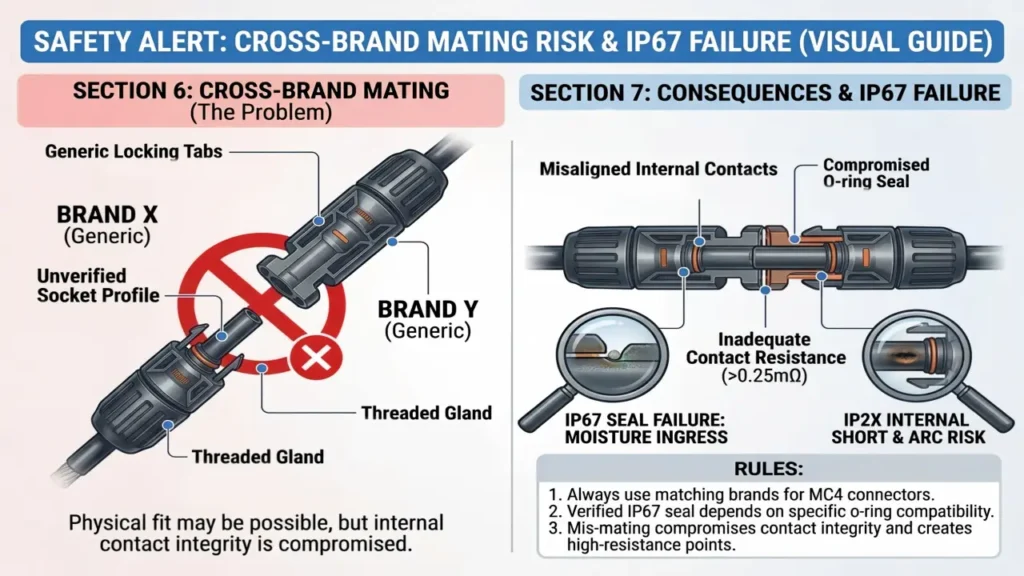
Why You Should Never Mix Different Connector Brands
MC4-style connectors from different manufacturers are frequently physically compatible — they’ll click together — but that doesn’t mean they’re electrically equivalent. Contact geometry, spring tension, and plating vary between brands, and mismatched pairs mate with a smaller effective contact area than same-brand pairs. Over years of thermal cycling and UV exposure, this shows up as elevated resistance, localized heating, and in worst cases, arc faults. This is exactly why the IEC 62548 design standard for PV array wiring calls for connectors of the same origin within a circuit, and why the U.S. National Electrical Code takes the same position on cross-mating.
Polarity, Voltage Limits, and Arc Fault Prevention
Always verify polarity before connecting, respect your equipment’s maximum voltage rating (accounting for cold-weather Voc rise), and never disconnect MC4 connectors under load — doing so can draw an arc across the contacts, pitting the pins and creating a permanent high-resistance point even if the connector still “works” afterward.
Fusing Requirements for Parallel Strings
When three or more strings are paralleled, individual string fusing is typically required so that a fault in one string can’t be fed by the combined current of all the others. The National Electrical Code Article 690 covers overcurrent protection requirements for PV source and output circuits in detail — check your local code before finalizing a multi-string design.
Common Wiring Mistakes to Avoid
- Wiring in series without checking cold-weather Voc, pushing string voltage above the inverter’s rated maximum
- Undersizing cable on parallel outputs, causing voltage drop and heat buildup at the connector
- Disconnecting MC4 connectors under load, which arcs and damages the contacts
- Mixing connector brands or batches within the same string or array
- Skipping string-level fusing on arrays with three or more parallel strings
- Using generic pliers instead of a proper MC4 crimping tool, resulting in loose crimps that loosen further under thermal cycling
How to Choose the Right MC4 Connectors and Cables for Your Wiring Plan
The last step in any MC4 connector wiring guide is turning your design into a purchasing spec — your wiring topology should inform what you buy, not the other way around:
Series-heavy residential designs need connectors rated for your system’s maximum string voltage (1000V or 1500V DC, depending on your inverter and local code) — check our MC4 connector specifications for a full ratings breakdown.
Parallel-heavy or off-grid designs should prioritize connectors and Y/T-branch adapters rated for the combined current of the parallel group, with margin above your calculated Imp.
Multi-string commercial projects benefit from sourcing connectors as a single batch with documented factory QC data, and from combiner boxes that centralize fusing and monitoring rather than daisy-chaining branch connectors across the array.
Bulk/OEM buyers — if you’re specifying connectors for repeat production runs or private-label products, our OEM/ODM program can match connector specifications, certifications, and packaging to your project requirements.
Frequently Asked Questions
Can I wire solar panels in series and parallel at the same time?
Yes — this is called series-parallel wiring and is standard for larger arrays. Panels are first wired in series to form strings that match your inverter’s voltage window, then multiple strings are wired in parallel using Y-branch connectors or a combiner box to reach your target current and power output. Following an MC4 connector wiring guide like this one for both stages helps avoid mismatched voltage windows or undersized parallel cabling.
What happens if I wire MC4 connectors backward?
Reversed polarity can damage the panel’s bypass diodes, trip your charge controller or inverter’s protection circuits, or in some cases damage the equipment itself. Always verify polarity with a multimeter before making the final connection, and rely on the factory-marked positive/negative leads rather than connector color alone.
Do I need a fuse for parallel MC4 connections?
For two panels in parallel, fusing is often not required if the combined current stays within the panel’s own overcurrent rating. For three or more strings in parallel, individual string fusing is typically required by code — check NEC Article 690 or your local equivalent standard before finalizing the design.
Can I mix MC4 connectors from different brands?
It’s not recommended. Many MC4-style connectors are physically compatible across brands, but differences in contact geometry and spring tension can cause elevated resistance and heat buildup over time. Standards bodies including IEC and NEC recommend keeping connectors within a circuit from the same manufacturer.
How many solar panels can I connect in series?
This depends on your inverter or charge controller’s maximum input voltage, the panel’s Voc rating, and the cold-temperature voltage correction for your climate. There’s no fixed panel count — the calculation must be redone for each combination of panel and inverter.
What size wire do I need for parallel MC4 connections?
Add the Imp (or Isc for worst-case sizing) of every panel in the parallel group, then select cable rated above that combined current with an appropriate safety margin. Longer cable runs may need to be upsized further to limit voltage drop.
Is it safe to disconnect MC4 connectors while the system is generating power?
No. Disconnecting under load can create an electrical arc across the contacts, which pits the metal and creates a permanent high-resistance point even if the connector continues to function afterward. Always de-energize the circuit — or work when irradiance is minimal — before disconnecting.