“MC4 connector” gets used as a catch-all term, but there are actually several distinct MC4 connector types on the market — each built for a different job in a PV string. Grab the wrong one and you can end up with a connector that’s under-rated for the current running through it, or a branch connector wired with the wrong gender on the wrong polarity.
This guide walks through every MC4 connector type available today — how each one works, what it’s built for, and the ratings that matter when you’re specifying or buying them. Since the basic MC4 design traces back to Multi-Contact/Stäubli’s original patent, most of these connector types share the same core locking mechanism, just adapted for a different job in the circuit. For the fundamentals — what MC4 stands for, connector anatomy, certifications — see our complete MC4 connector guide.
Quick Overview: MC4 Connector Types at a Glance
The table below summarizes all seven MC4 connector types covered in this guide before we get into the detail on each one.
| Type | Function | Typical Current Rating |
|---|---|---|
| Standard pair (M/F) | Panel-to-cable, cable-to-cable, series strings | 20–30A |
| Y-branch / T-branch (2-to-1) | Combine 2 strings in parallel | 20–30A |
| Y-branch (3-to-1 / 4-to-1) | Combine 3–4 strings in parallel | 25–30A+ |
| Extension cable | Extend string length to combiner box/inverter | Matches cable gauge |
| Inline fuse connector | Overcurrent protection per string | Fuse-rated (10–25A) |
| Diode connector | Block reverse current between strings | 20–30A |
| MC4-EVO2 | Utility-scale, 1500V systems | Up to 30A @ 1500V |
1. Standard MC4 Pair (Male/Female)
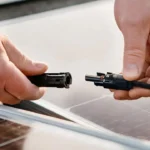
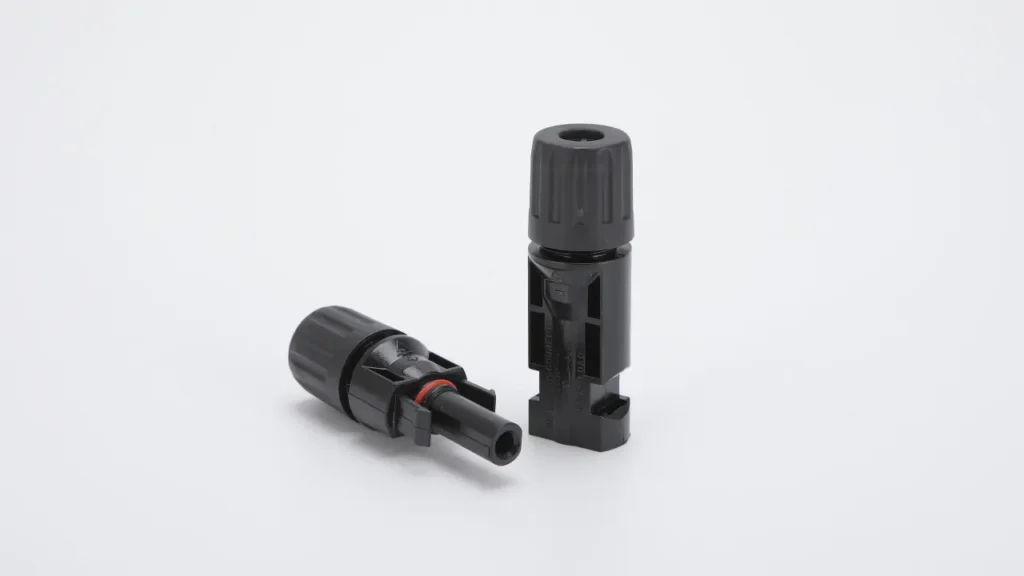
This is the connector most people picture when they hear “MC4” — a single male plug and single female socket, sold pre-attached to nearly every solar panel manufactured today. Standard pairs are used for two jobs: connecting a panel directly to the next component in a series string, and joining two cable-terminated ends together (panel to extension cable, extension cable to combiner box lead).
Rated current on a standard pair is typically 20–30A depending on the manufacturer and cable gauge it’s crimped to, with a rated voltage of 1000V DC (1500V on newer EVO2-generation connectors — see below).
2. Y-Branch and T-Branch Connectors
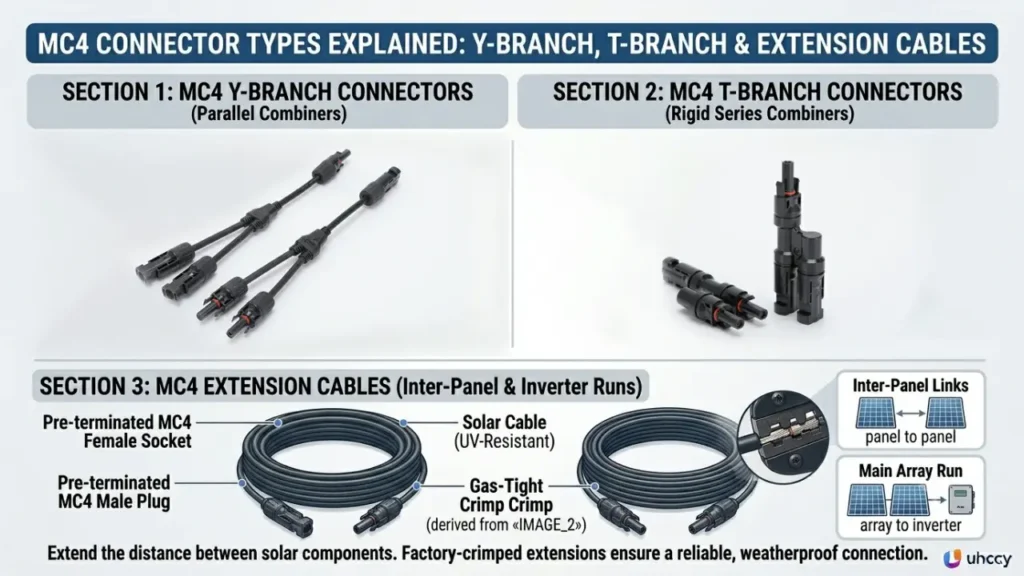
Branch connectors — sold as “Y-connectors,” “T-connectors,” or “MC4 branch connectors” interchangeably in most catalogs — are what you reach for when you need to wire strings in parallel rather than series. Instead of running every string all the way back to the combiner box individually, a branch connector merges 2 to 4 string outputs into a single output cable.
How branch connectors are configured
Branch connectors are sold in sets of two, gender-mirrored, and the configuration is described by the number of inputs to outputs:
- 2-to-1 — the most common configuration, used to combine two strings. Comes as one female-input-to-two-male-outputs unit and one male-input-to-two-female-outputs unit.
- 3-to-1 — combines three strings, used in larger residential or small commercial arrays.
- 4-to-1 — combines four strings, common in commercial and utility-scale combiner setups, and typically built with a higher current rating and larger housing to manage the added heat load.
Gender is not optional — it’s a safety rule
Branch connectors are gender-specific for a reason, not a manufacturing quirk: the positive line needs a female-input, multiple-male-output connector, while the negative line needs the mirror image (male-input, multiple-female-output). Installing the wrong gender on the wrong polarity is one of the more common wiring mistakes on parallel arrays, and it creates a short rather than a working connection.
Sizing the current rating correctly
This is the step most guides skip, and it’s the one that actually prevents overheating. When you combine strings in parallel, the branch connector’s output has to carry the sum of every input string’s current — not just one string’s worth. A commonly used sizing approach follows NEC’s continuous-current guidance: add up the rated current of every string feeding into the branch connector, then apply a 1.25x safety factor. Two strings rated at 10A each, for example, call for a branch connector rated for at least 25A (20A × 1.25) — not a bare-minimum 20A unit.
The main output cable also needs to be sized for that combined current, while the individual branch legs only need to carry a single string’s current (commonly 2.5mm²/4mm² branch legs feeding a 4mm²/6mm² main output cable).
Overcurrent protection
Because parallel strings combine current, most branch-connector installations also need string-level overcurrent protection — typically an inline MC4 fuse connector on the positive lead of each string (see below) — since the combined current can exceed a single panel’s series fuse rating even when each individual string is within its own limit.
A note on mixing panel brands or voltage classes
Branch connectors work best when every string feeding into them is matched — same voltage, ideally the same panel model. A voltage mismatch between paralleled strings can cause the higher-voltage string to back-feed into the lower-voltage one, which is a system design issue no connector rating can compensate for.
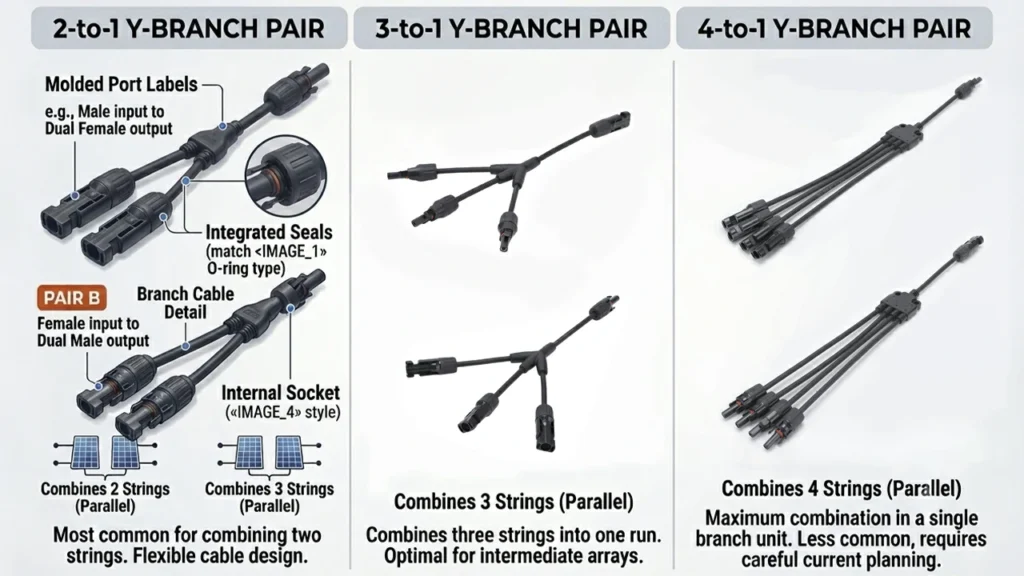
MC4 Y branch connector 2 to 1 3 to 1 4 to 1 comparisonFor full wiring layouts showing exactly where branch connectors go in a string, see our MC4 connector wiring diagram guide.
3. MC4 Extension Cables
An MC4 extension cable is simply a length of PV wire with a factory-crimped male connector on one end and a female on the other — sold in common lengths from roughly 10 to 50 feet. They’re used to route a string to a combiner box, charge controller, or inverter without doing any additional field crimping, which makes them a fast, low-risk option compared to cutting and terminating cable on-site.
When choosing one, match the cable gauge to your string’s current (not just “whatever’s available”) and confirm the voltage rating matches the rest of your system — 1000V is standard, 1500V for utility-scale.
4. Inline Fuse Connectors
An inline fuse connector looks like a standard MC4 housing but has a fuse holder built into it, used to add string-level overcurrent protection without a separate fuse combiner box. These are especially relevant on parallel-wired arrays using Y-branch connectors, where the combined current can exceed what a single string’s wiring was designed to carry safely. Fuse ratings commonly available run from around 10A to 25A — the correct size depends on the panel’s specified series fuse rating, not a generic default.
5. Diode Connectors
A diode connector houses a blocking diode inside a standard MC4 shell, preventing current from flowing backward into a string with lower output (from partial shading, for instance). They’re less common in new installations today, since most modern inverters and combiner boxes handle blocking/bypass functions at the string or module level instead — but they still show up in off-grid and older parallel-wired systems where that protection isn’t built in elsewhere.
6. MC4-EVO2 (1500V Generation)
MC4-EVO2 is Stäubli’s newer connector generation, built for the 1500V DC systems increasingly used in utility-scale solar. It carries the same core locking mechanism and general form factor as classic MC4, but the critical detail is compatibility: EVO2 is only backward-compatible with classic MC4 when both connectors are genuine Stäubli parts of a certified matching size. Pairing an EVO2 connector with a non-Stäubli “MC4-compatible” part isn’t a certified combination, even if the two physically click together.
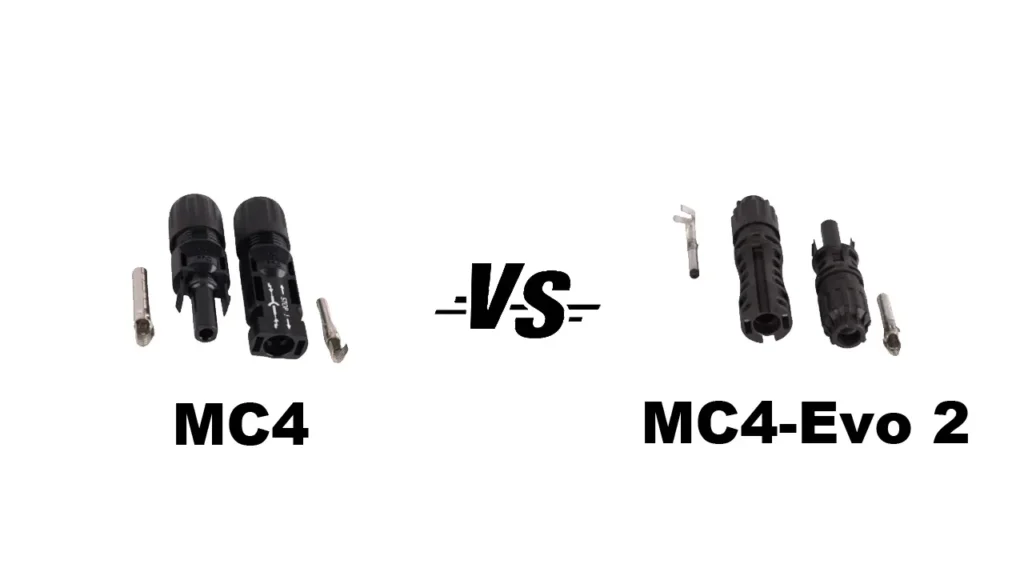
MC4 EVO2 1500V connector compared to classic MC4Choosing the Right MC4 Connector Type for Your Project
With seven MC4 connector types to choose from, the fastest way to pick the right one is to start from what you’re trying to accomplish in the circuit, not from the part number:
| If you need to… | Use |
|---|---|
| Connect panels in a series string | Standard MC4 pair |
| Combine 2–4 strings in parallel | Y-branch / T-branch connector, sized with the 1.25x current rule |
| Extend a string to the combiner box/inverter | MC4 extension cable |
| Add string-level overcurrent protection | Inline fuse connector |
| Prevent reverse current on older parallel setups | Diode connector |
| Build a 1500V utility-scale system | MC4-EVO2 (matched Stäubli pairs only) |
For voltage, current, and certification numbers behind these ratings, see our MC4 connector specifications guide. If you’re sourcing any of these connector types in volume, our MC4 connector supplier guide covers what to check before placing a bulk order — or go straight to our MC4 Connector product page for current specifications and pricing.
FAQ
What’s the difference between a Y-branch and a T-branch MC4 connector?
In most catalogs the terms are used interchangeably for the same function — combining parallel strings — though housing shape can differ slightly between suppliers. What matters more than the name is the current rating and certification of the specific product.
Can I use a regular MC4 connector instead of a Y-branch connector for parallel wiring?
No. Standard MC4 connectors aren’t built to safely combine parallel currents — Y-branch connectors have internal current-distribution paths and higher ratings specifically designed for that job.
How do I size a Y-branch connector for my strings?
Add up the rated current of every string feeding into it, then apply a 1.25x safety factor. Two 10A strings need a branch connector rated for at least 25A.
Do I need a fuse with a Y-branch connector?
Usually yes, on the positive lead of each string, since combined parallel current can exceed a single panel’s series fuse rating even when each string alone is within limits. Check your panel’s datasheet for its specified series fuse rating.
Is MC4-EVO2 compatible with standard MC4 connectors?
Only when both connectors are genuine Stäubli parts of a matched, certified size. Non-Stäubli “MC4-compatible” connectors aren’t certified for cross-mating with EVO2.
How many MC4 connector types are there?
Seven main types cover nearly every use case: standard pairs, Y-branch/T-branch connectors (2-to-1, 3-to-1, 4-to-1), extension cables, inline fuse connectors, diode connectors, and the newer 1500V MC4-EVO2.
Key Takeaways
- Of the seven MC4 connector types covered here — standard pairs, Y/T branch, extension cables, fuse connectors, diode connectors, and MC4-EVO2 — each serves a distinct role, and matching the type to the job matters as much as matching the brand.
- Branch connectors are gender-specific by polarity: female-in/multi-male-out for positive, male-in/multi-female-out for negative.
- Size branch connectors using total combined string current × 1.25, not the rating of a single string.
- Parallel-wired strings usually need string-level fuse protection in addition to the branch connector itself.
See the full picture in our MC4 Connector: The Complete Guide, or browse current specifications on our MC4 Connector product page.